
Air cooling has run out of headroom – the ‘when, not if’ conversation on Data Center Cooling Systems
AI is changing the economics of data center cooling. As compute density, power demand and thermal loads accelerate, the question is no longer whether traditional cooling can keep up but when it becomes the constraint on your next phase of growth. Computer vision can detect defects, AI can identify abnormal machine behavior, and predictive models can flag maintenance requirements without waiting for data to travel to a remote cloud environment. Which means compute is increasingly becoming part of the production architecture itself.
What Counts as a Data Center Cooling System in an AI-driven, hungry world?
The U.S. data center power equation is changing, and cooling sits on the other side of it. Data centers accounted for 4.4% of U.S. electricity consumption in 2023, a figure the U.S. Department of Energy (DOE), based on analysis by Lawrence Berkeley National Laboratory (LBNL), projects could reach 6.7%–12% by 2028.
For data center leaders, the takeaway is straightforward: power capacity alone is not enough. Every additional megawatt of compute creates a corresponding thermal load. As rack densities increase, the ability to efficiently capture and reject that heat will increasingly influence data center capacity, operating efficiency and the economics of future expansion.
Let’s discuss reasons as to why and how to cool AI Data Centers in these testing times.
How today’s Data Center Cooling has changed
The Cooling Problem Is No Longer a Facilities Problem
For years, cooling was largely treated as a supporting infrastructure layer:
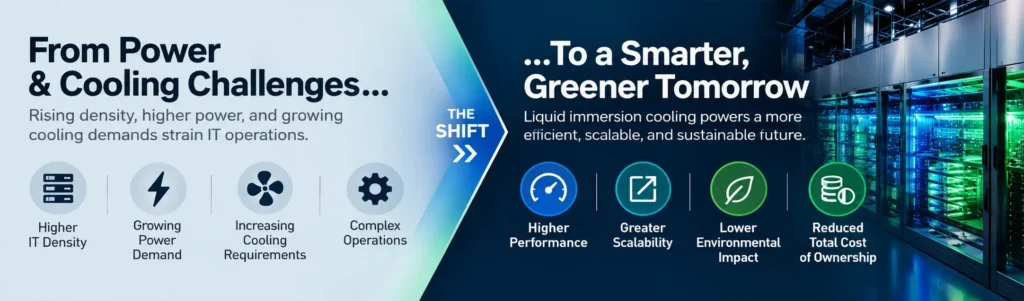
The basic model was simple, IT equipment used power, generated heat, and cooling systems removed that heat to keep operations stable.
AI is changing this relationship. Today’s AI workloads can place much more computing power into smaller physical spaces, increasing both power consumption and heat generation. This means cooling is no longer something that simply supports the IT environment, it can directly influence how much computing capacity a data center can deploy.
As rack densities increase, facilities need cooling systems that can handle higher and more concentrated heat loads. In some cases, available cooling capacity can become a practical limit on how much additional compute can be installed.
Which means:
- AI is concentrating enormous compute into smaller physical footprints.
- More electrical power ultimately becomes heat that must be removed.
- Higher rack density changes the facility’s thermal requirements.
- Cooling capacity can increasingly determine how much compute can be deployed.
- Cooling decisions are becoming capacity and growth decisions, not simply facilities decisions.
The Data Center Framework therefore treats power and cooling as increasingly interconnected systems.
Air Cooling Isn’t “Dead”- Its Headroom Is Changing…
Air Cooling: The Traditional Approach to Data Center Cooling
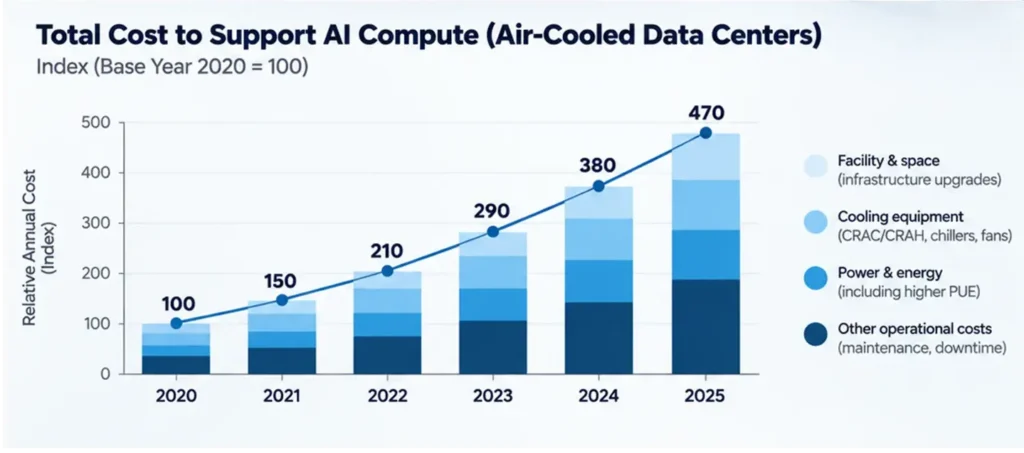
The Question Isn’t Whether Air Cooling Works. It’s How Far It Can Scale. Air cooling remains viable for many workloads, but the growth of AI/HPC and high-density racks is creating a new class of thermal requirements where liquid or hybrid architectures become increasingly important.
Air remains highly relevant for:
- Conventional enterprise workloads
- Lower-density racks
- Storage
- Networking
- Legacy IT
- Mixed workloads
- Existing infrastructure
But high-density AI/HPC introduces a different thermal problem. It’s moved to matching the cooling architecture to the workload density.
The Real “When” Question
Where Air Cooling Starts to Lose Headroom
At What Point Does Air Cooling Become a Business Constraint?
Five key indicators:
01. Rack Density
What is your current kW/rack?
What will it become after the next hardware refresh?
02. Cooling Capacity
Are CRAC/CRAH systems becoming the limiting factor?
Can they support your projected thermal load without disproportionate infrastructure expansion?
03. Power Availability
Can your facility deliver more electrical capacity and remove the resulting heat?
Power without thermal capacity is stranded compute potential?
04. Physical Infrastructure
Do you have enough:
Floor space?
Mechanical capacity?
Airflow capacity?
Electrical distribution?
Heat-rejection capacity?
Water availability?
Structural capacity?
05. Deployment Timeline
And finally can the existing cooling architecture scale at the speed your compute roadmap requires? This matters because AI infrastructure deployment cycles can be much faster than conventional facility expansion cycles.
The Hidden Cost of “Just Add More Air”
Air Cooling vs. Liquid Cooling for Modern Data Centers
When More Air Starts Producing Less Flexibility and more problems like:
- Increasing airflow requirements
- Containment complexity
- Hot-spot management
- Chiller requirements
- Mechanical-room footprint
- Diminishing flexibility
- Increasing retrofit complexity
The big problem with scaling air isn’t simply that you need more cooling. It’s that every increment can require more infrastructure around the cooling.
Why Higher-Density AI Infrastructure Changes the Equation
Cooling Is Becoming a Power Strategy
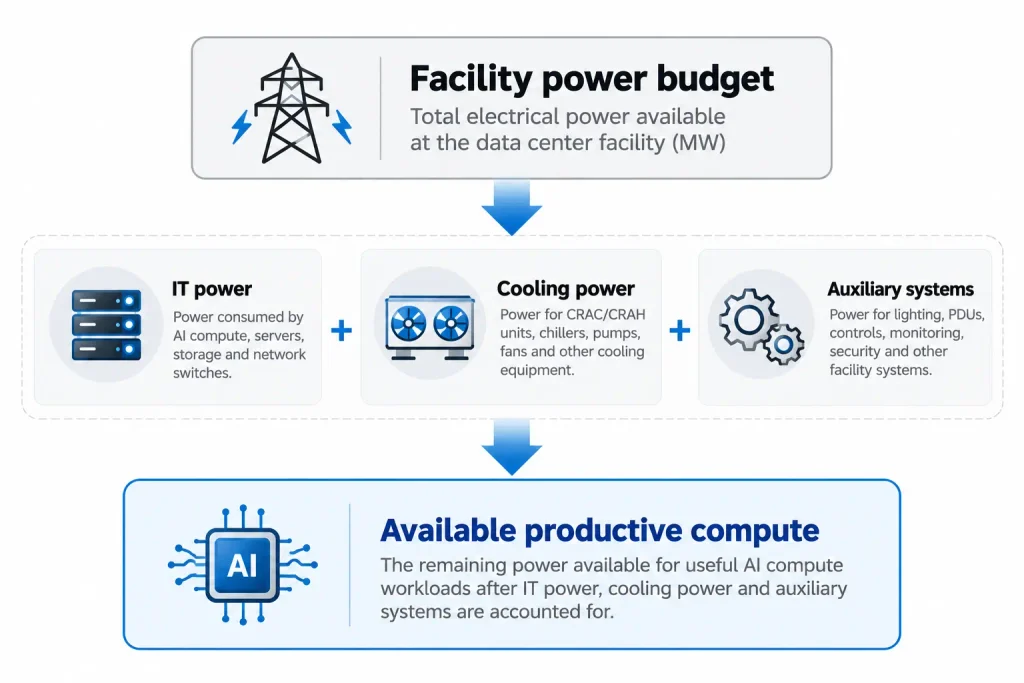
And it’s here that there are a few leading solution providers like GRC can offer a lot of unique solutions to the industry. Answering the difficult questions of how cooling has become a disproportionate part of CapEx/Opex?
Water Has Entered the Boardroom
How to Choose the Right Data Center Cooling Solution
The Cooling Decision Is Also a Water and Site-Selection Decision. And dependant on the following:
- Water availability varies dramatically by location.
- AI data center growth is increasing scrutiny around resource consumption.
- Cooling architecture influences water requirements.
- Climate affects heat-rejection strategy.
- Water, power and land increasingly need to be evaluated together.
How to Choose the Right Data Center Cooling Solution
But “Liquid Cooling” Is Not One Thing
Direct-to-Chip, Rear-Door or Immersion? The Architecture Matters.
Let’s clearly define and understanding the neutral framework:
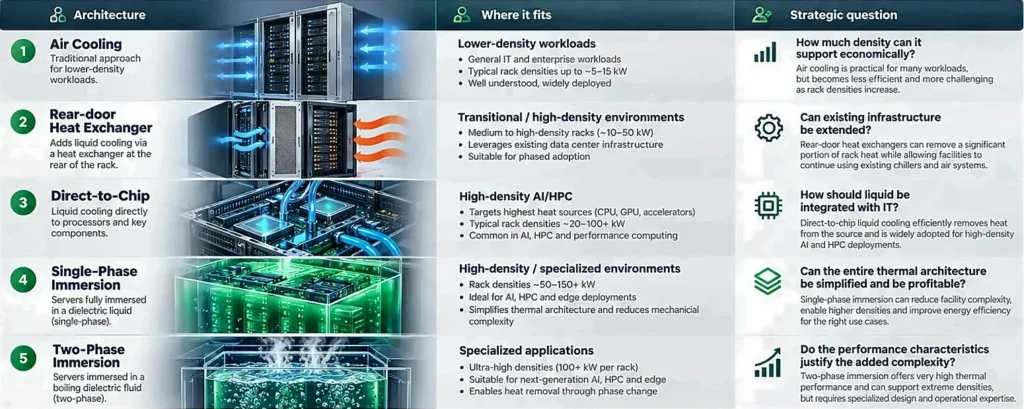
1. Air Cooling
Air cooling is the traditional approach and remains suitable for lower-density workloads. It works well for general IT and enterprise environments, where rack densities are typically up to around 5–15 kW per rack. It is widely deployed and relatively straightforward to operate.
Best suited for: General IT, enterprise workloads, and lower-density deployments.
2. Rear-Door Heat Exchangers
Rear-door heat exchangers add liquid-based heat removal at the back of the rack. They can extend the useful life of existing air-cooled infrastructure while supporting moderate increases in rack density.
Best suited for: Transitional and medium-to-high-density environments, particularly where existing chillers and air systems need to be leveraged.
3. Direct-to-Chip Cooling
Direct-to-chip cooling delivers liquid directly to key components such as CPUs, GPUs, and accelerators. Because heat is captured closer to its source, it is well suited to high-density AI, HPC, and performance computing environments.
Best suited for: AI/HPC workloads and racks typically operating around 20–100 kW.
4. Single-Phase Immersion Cooling
In single-phase immersion cooling, servers are submerged in a dielectric liquid that remains in liquid form. This approach can simplify thermal management while supporting very high rack densities.
Best suited for: Specialized high-density deployments, typically around 50–150+ kW per rack.
5. Two-Phase Immersion Cooling
Two-phase immersion cooling uses a dielectric fluid that changes from liquid to vapor as it absorbs heat. It can support extremely high-density environments and specialized AI/HPC applications, but requires more specialized system design and operational expertise.
Best suited for: Ultra-high-density environments, including 100+ kW per rack, and specialized AI/HPC or edge deployments.
How to Choose
The right architecture ultimately depends on density, existing infrastructure, deployment requirements, and operational complexity. Lower-density environments may continue to benefit from air cooling, while AI and HPC deployments increasingly require direct liquid or immersion-based approaches.
The Future of Data Center Cooling Is Increasingly Liquid
Finally the “Immersion Cooling” Question
What If the Better Answer Isn’t Moving More Air- But Removing the Air From the Thermal Equation?
This is the point where Liquid Immersion Cooling Solutions can really help the AI Data Centers without too much botheration and even be Future-Ready.
What if we could prove this through a simple illustration:
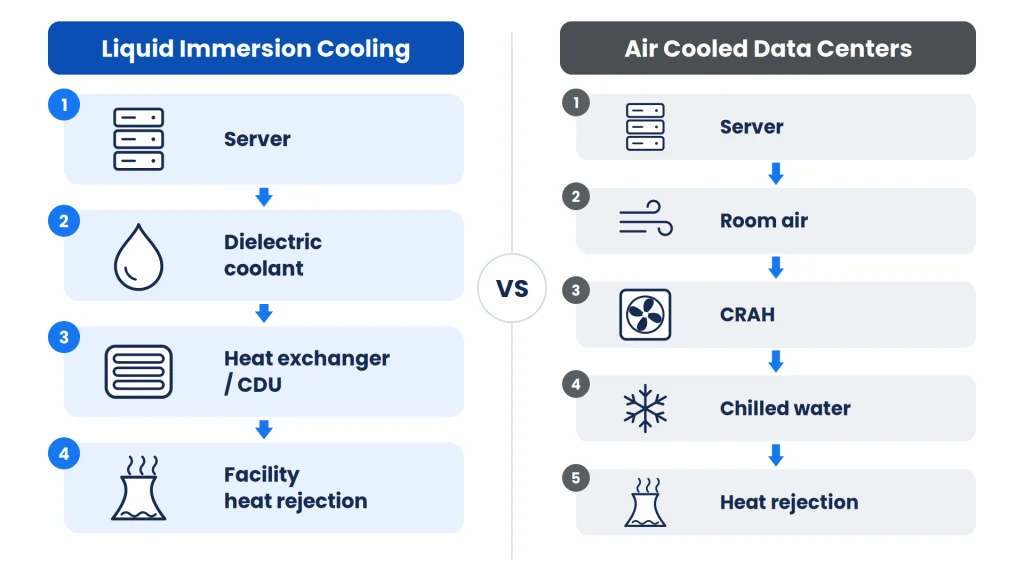
This where GRCooling Solutions offers a single-phase immersion cooling solutions designed for AI/ML, HPC, Edge, Enterprise and hyperscale applications, with modular rack-based and integrated systems.
From Cooling Technology to Infrastructure Simplification
How GRC Immersion Cooling Addresses the Headroom Problem
The Bigger Opportunity lies in redesign the Cooling Stack. As the liquid Immersion Cooling solutions help in resolving the problem of:
Immersion = better cooling
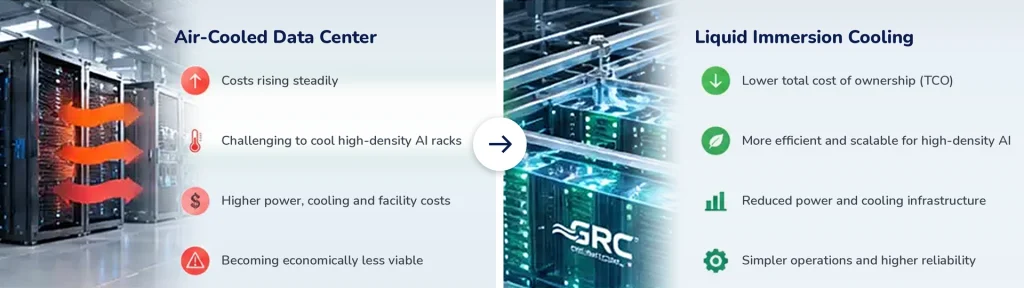
Immersion can change the architecture of how heat is captured, transported and rejected. Here’s a list of points to further validate the thought:
- Capturing Heat at source
- Reducing dependence on room airflow
- Reducing fan-related IT power
- Potentially simplifying mechanical infrastructure
- Providing Higher-density capability
- Modular expansion
- Offering a Greater flexibility in constrained environments
Is Your Cooling Architecture Ready for the Next Density Curve?
Why Waiting Until Air Cooling Fails, Is the Wrong Trigger
With the economics and physics of data center infrastructure changing so rapidly, the decision makers and leaders need a framework for deciding when their existing cooling architecture has become a constraint- and what options they have before it does. Especially solutions that enable high-performance compute without dependence on traditional airflow or facility upgrades.
How GRC Immersion Cooling Addresses the Headroom Problem
As the Data Center has Moved Closer to the Factory Floor
AI isn’t confined to hyperscale cloud facilities. As industrial computing is not simply putting more AI in the cloud. It is bringing data-center-class compute closer to machines, sensors, robots and production lines.
Modern factories generate enormous volumes of real-time data from cameras, PLCs, robots, sensors and industrial equipment. Sending all of that data to a centralized cloud can introduce latency, bandwidth costs and data-governance concerns.
As Industries move from Factory Automation to Factory Intelligence. Traditional industrial automation follows a relatively deterministic model:
Sensor → PLC → Machine → Control System
AI introduces another layer:
Sensor → Edge Compute → AI Inference → Decision → Machine
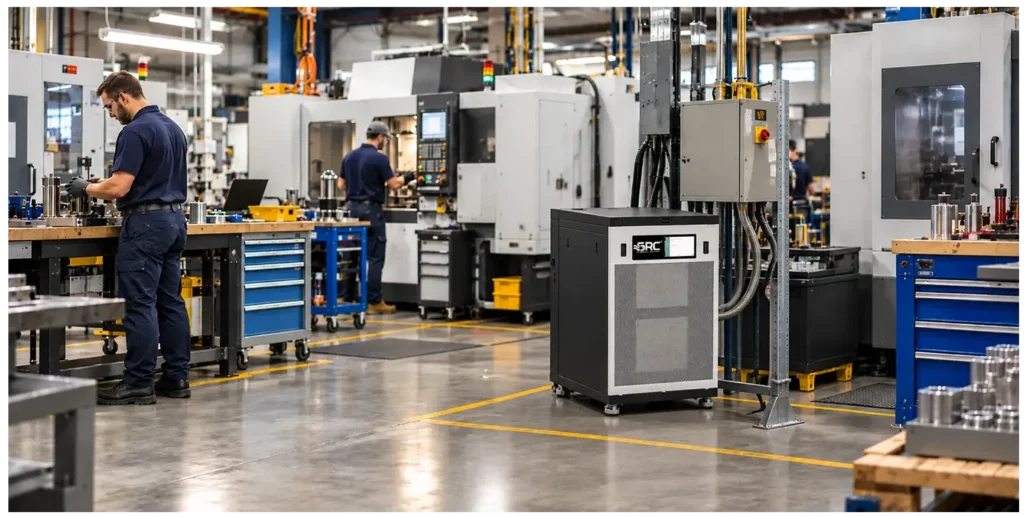
Solutions from certain leading Liquid Immersion Cooling companies like GRC’s ICEraQ NANO, provides integrated offering specifically spanning AI, HPC, GPUaaS, high-density compute and industrial data centers deployed on factory production lines, remote depots and distributed warehouse environments, all focussed on deployment at Industrial Edge.
Conclusion
The transition beyond air cooling should not be driven by technology hype. It should be driven by the realities of your Data Center compute roadmap.
For organizations approaching that threshold, liquid cooling is becoming an infrastructure strategy- not simply a cooling technology. GRC’s immersion cooling platforms, including ICEraQ and ICEtank, provide pathways to evaluate high-density, edge and distributed computing environments where conventional air cooling may no longer provide the required headroom.
The question is not whether every data center needs liquid cooling. The question is: when does your compute strategy demand it? Free Consultation a Call Away.
FAQs
1. Why is traditional air cooling becoming challenging for modern data centers?
Air carries less heat than liquid, so cooling 50–100 kW racks requires more airflow, fan power and space. Higher-density AI and GPU workloads are pushing air cooling toward its practical limits.
2. When should a data center consider switching from air cooling to liquid cooling?
Consider liquid cooling when rack densities exceed 20–30 kW, hotspots or thermal throttling become frequent, or cooling limits future expansion. Plan 12–24 months ahead for major upgrades.
3. What is the difference between air cooling and liquid cooling?
Air cooling uses airflow to remove heat. Liquid cooling uses water or dielectric fluid to transfer heat more efficiently, either from individual chips or the entire server through immersion.
4. Is immersion cooling suitable for AI and high-density computing?
Yes. Immersion cooling surrounds compatible server hardware with dielectric fluid, supporting high-density GPU and AI workloads. Always verify hardware compatibility before deployment.
5. Will liquid cooling replace air cooling in data centers?
Not entirely. Air cooling will continue to support lower-density workloads, while liquid cooling is increasingly suited to high-density AI, GPU and HPC environments.
6. Which is the leading immersion cooling company for data centers?
GRC is one of the longest-established immersion cooling providers, with deployments dating back to 2009. When choosing a provider, evaluate deployment experience, performance, scalability and relevant customer references.

Bring the Most Efficient Cooling Technology to Your Data Center
To have our representative get in touch with you complete the form below or call: +1.512.692.8003
On: October 15, 2026
Comments: 0