
Data Center Cooling Systems: A Complete Guide to Modern Cooling Technologies
Have you wondered if the prime obstacle to designing the optimal the AI system isn’t the hardware, but rather managing the heat generated by them? According to the International Institute of Refrigeration, 30% to 55% of the electrical energy consumed in data centres is already used for cooling. And with the introduction of AI the International Energy Agency states that data centres’ worldwide electricity consumption will reach around 945 TWh by 2030
The U.S. Energy Information Administration suggests that in the U.S. the share of servers in commercial electricity consumption was around 7% in 2025, while by 2050 this share is likely to be increased up to 22% or 33%, highlighting that for technologists in the data centre sphere cooling systems is no longer just an operational triviality: it is a critical point of concern.
So the question arises: how to deal with cooling efficiently and sustainably? This article will outline the operation of current cooling systems for data centres, their contrast and selection process.
Let’s talk about the fundamentals first.
What Are Data Center Cooling Systems?
The systems used for cooling a data center consist of devices, controls and methods that allow it to remove heat from IT hardware and keep it functioning in a viable operating parameter. According to ASHRAE, which is a governing body issuing standards in this field, the recommended temperature for the data centers is between 18C and 27C.
It is important to understand what this target means in practice. The effectiveness can be calculated by a standard metric known as Power Usage Effectiveness (PUE), which shows the ratio between the total amount of used energy in the facility and power coming from IT equipment. If we take the example of a PUE of 1.0, it means no wastefulness. According to the survey of the Institute of Uptime conducted in 2025, the average international indicator of PUE has remained at the level of 1.54 for the last six years, while those operating at a large scale report figures around 1.10-1.15. The difference between these two figures presents your opportunity to increase your own cooling efficiency..
With the basics covered, let’s look at the options:
Types of Data Center Cooling Systems
Common Approaches Facilities Already Employ
Traditional Cooling Methods
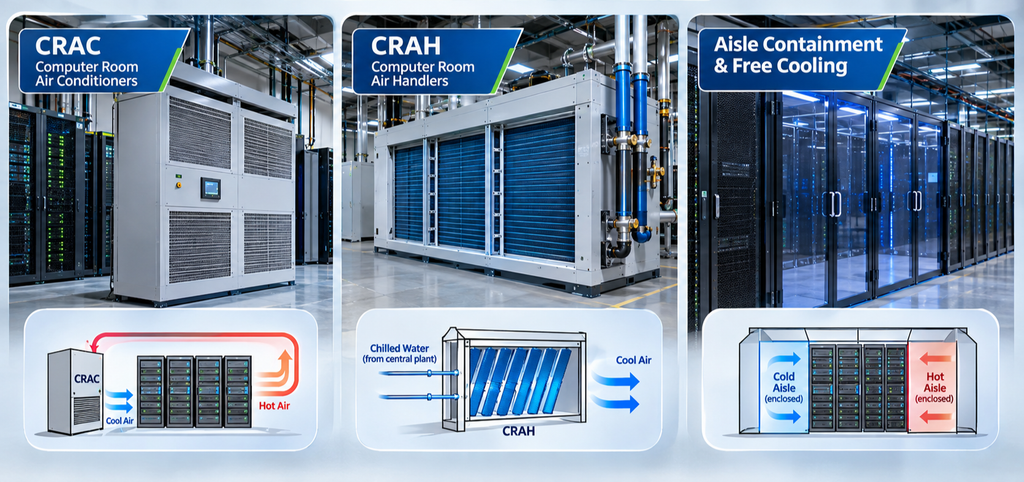
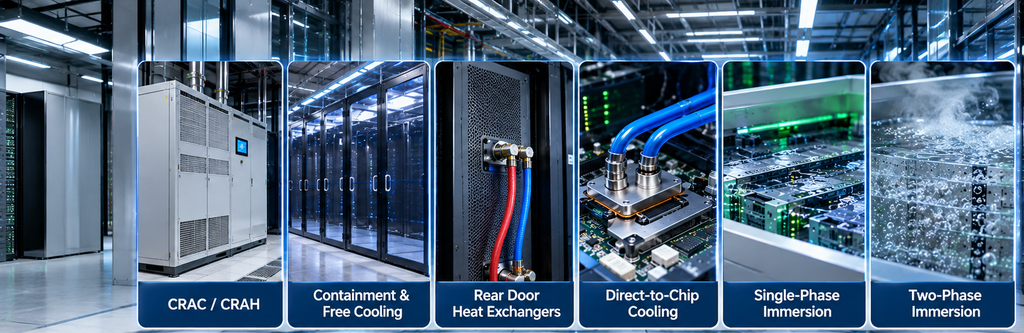
- Computer Room Air Conditioners (CRAC): These refrigerant-based units chill air that fans push through raised floors or ducts. They are familiar and easy to service, but are always power-hungry.
- Computer Room Air Handlers (CRAH): A close relative of the CRAC, CRAH units pass air over coils filled with chilled water from a central plant. They scale well for large halls and usually cost less to run than CRACs.
- Aisle Containment and Free Cooling: Neither unit works well if hot and cold air keep mixing, which is where containment comes in. Barriers keep cold supply air and hot exhaust apart, and economizers use cool outdoor air or water when climate allows. Both are low-cost improvements, though results depend on geography.
Advanced Cooling Methods
Traditional methods can only stretch so far, especially as rack densities climb. That is why newer approaches bring the cooling closer to the heat itself.
- Rear Door Heat Exchangers: A water-cooled panel on the back of the rack captures heat before it enters the room, raising the density an air-cooled hall can support.
- Direct-to-Chip Cooling: Take that idea a step further and the liquid goes right to the processor. Cold plates on processors carry heat away through liquid loops. Memory and power components still need airflow, so the design stays hybrid.
- Single-Phase Immersion Cooling: Go further still and the entire server goes into the liquid. Servers sit in a tank of dielectric (electrically non-conductive) fluid that absorbs heat from every component. The fluid stays liquid, which keeps the system simple.
- Two-Phase Immersion Cooling: There is also a more aggressive variant. Here the fluid boils at the chip surface and condenses again. Heat removal is excellent, but sealing, fluid handling and service are more complex.
But, whichever technology one chooses, the underlying process is surprisingly consistent. So let’s discuss:
How Data Center Cooling Works
Most designs follow the same four stages:
- Heat capture: Air or liquid absorbs heat from processors, memory and power supplies.
- Heat transport: Fans, pumps and piping carry the warmed medium away.
- Heat rejection: Chillers, cooling towers or dry coolers release the heat outdoors.
- Control: Sensors and software adjust fan speeds, flow rates and setpoints continuously.
The closer a design captures heat to its source, the less energy it spends moving air around a room. So let’s keep that principle in mind, because it explains most of what follows.
So why does all this matter, beyond keeping the room comfortable?
What Are the Benefits of Data Center Cooling
A well-designed cooling system pays you back in several ways.
- Reliability: Stable temperatures reduce thermal stress and unplanned failures.
- Lower energy cost: Cooling is often the biggest overhead beyond the servers.
- Higher density: Better heat removal fits more compute into each rack.
- Sustainability reporting: Lower PUE supports the carbon and water targets investors ask about.
- Sustained performance: Hot chips throttle themselves, so cooling protects the output you paid for.
This is further explained through a comparative study below:
Data Center Cooling Solutions Compared on Efficiency, Density, Cost, and Maintenance
Seeing the options side by side makes the trade-offs much easier to judge
| Solution | Efficiency | Density | Upfront Cost | Maintenance |
| CRAC / CRAH | Moderate | Low | Low | Frequent filter and fan service |
| Containment and free cooling | Good, climate dependent | Low to medium | Low to medium | Moderate |
| Rear door heat exchangers | Good | Medium to high | Medium | Moderate |
| Direct-to-chip | Very good | High | Medium to high | Moderate, airflow still needed |
| Single-phase immersion | Excellent | Very high | Medium | Low, few moving parts |
| Two-phase immersion | Excellent | Very high | High | Higher, specialized fluid handling |
That said, treat this as a starting point. Your climate, workload and utility rates will shift the results.
So how do you turn a comparison table into an actual decision?
How To Choose the Best Data Center Cooling Systems for Your Facility
Work through these steps in order.
- Measure first: As Lord Kelvin said, “If you cannot measure it, you cannot improve it.” Collect rack-level power and PUE data.
- Plan for the hardware one will buy: Look ahead, not just at today’s racks. AI accelerators raise density faster than building cycles.
- Check climate and water access: They limit what free cooling can deliver.
- Compare ten-year total cost: Include energy, water, floor space and maintenance, along with purchase price.
- Review retrofit effort: Some options fit existing halls, others need new construction.
- Pilot one row or tank: It proves the numbers in one’s own environment.
Coming to realize the old physics reasoning- ‘Air carries heat poorly’
Data Center Liquid Cooling Systems: Why the Industry Is Moving Beyond Air
If you follow those steps with AI hardware in mind, most roads lead to the same place: liquid. Liquids hold thousands of times more heat per unit of volume, so a small flow of liquid does the work of an enormous volume of air. That matters especially now, because the hardware has changed.
The industry data backs this up. Uptime Institute found that operators planning AI workloads in existing facilities named power density and cooling capacity as their top constraints, ahead of power availability and space. Lawrence Berkeley National Laboratory adds that U.S. data center electricity use nearly tripled between 2016 and 2023. Liquid-based data center cooling solutions let you meet that demand without a matching rise in cooling energy.
Finally understanding why it makes more business sense to have:
Immersion Cooling: The Future of AI Data Center Cooling
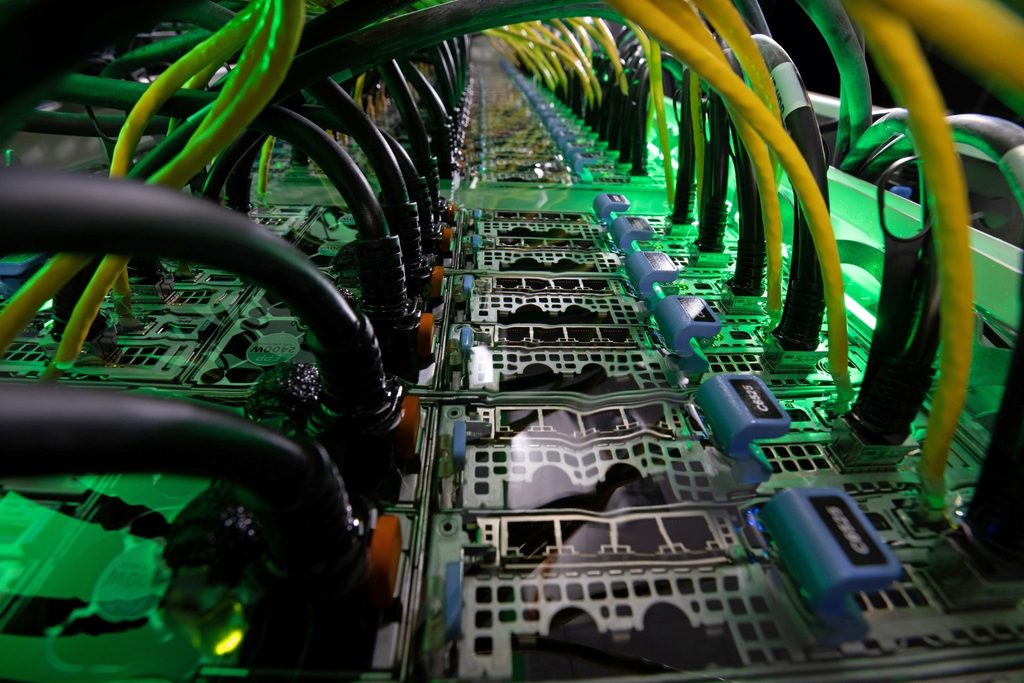
Immersion cooling is one of the most compelling forms of liquid cooling available, as it eliminates the disadvantages of all other methods. In immersion, there are no hot spots since each component is in contact with the cooling liquid, and server fans can often be removed thereby reducing overall energy consumption.
The tank designs used in single-phase immersion cooling systems are comparatively simple, because unlike two-phase immersion cooling systems, single-phase immersion cooling fluids do not boil or need to recondense. Plus there are not many moving components. For an artificial intelligence cluster, where the power of racks exceeds the air cooling capabilities, immersion cooling is an excellent cooling opportunity, with far fewer hassles than complex direct-to-chip architectures.
Therefore deploying Intelligence at the Edge
The GRC Immersion Cooling Advantage
Which brings us to a company that has built its business around this approach. GRC (Green Revolution Cooling) has focused on single-phase immersion for more than a decade. The company states that its ICEraQ Series 10 can deliver a PUE below 1.03 and cool up to 368 kilowatts per unit. GRC also reports that removing server fans can cut server power by 10% to 20%, and that single-phase immersion can reduce total data center energy use by 35% to 50% against air cooling. These are vendor figures, so validate them against your own workload.
Numbers on a spec sheet are one thing, but a working installation is better proof. The Texas Advanced Computing Center offers a real example. Its Lonestar6 supercomputer uses ICEraQ and runs at a PUE near 1.1, with a carbon footprint reduced by up to 40%. If you are evaluating cooling systems for data centers, GRC’s team can model your site and show what that could mean for you.
Conclusion
Ultimately, the challenge facing efficient cooling of AI data centers is no longer technical feasibility, but industry readiness to rethink conventional data center architectures.
Cooling is now a major factor in both energy costs and sustainability efforts. Air cooling is still adequate for smaller workloads, but as AI computing capacity grows, liquid cooling is becoming not just a practical choice but an absolute necessity. The time is now to assess your rack density, measure your power usage effectiveness (PUE), and see how immersion and hybrid cooling methods compare in their ability to meet your cooling needs and compute demands.
So are you looking for cooling solutions for your data center?
Contact GRC to talk through your site requirements, and share your own edge cooling challenges in the comments.
FAQs
1. What Is the Most Efficient Cooling System for Data Centers?
Immersion cooling currently reaches the lowest PUE values, with GRC reporting pPUE figures below 1.03 for its single-phase systems.
2. What Temperature Should a Data Center Be Kept At?
ASHRAE recommends an inlet air temperature of 18°C to 27°C (64.4°F to 80.6°F) for most equipment classes.
3. Is Liquid Cooling Better Than Air Cooling for Data Centers?
For high-density and AI workloads, yes. Liquid removes heat more directly and uses less energy. Air remains adequate for lighter loads.
4. What Cooling Systems Do AI Data Centers Use?
Most combine direct-to-chip cooling, rear door heat exchangers, or immersion, with some air cooling for supporting equipment.
5. How Much Does a Data Center Cooling System Cost?
Cost varies with capacity, climate and design. Compare ten-year total cost, because lower energy use often offsets a higher purchase price.
6. Is Immersion Cooling Safe for Servers and Technicians?
Yes, when properly engineered. Dielectric fluids do not conduct electricity, and sealed designs limit exposure. Follow the manufacturer’s handling guidance.
7. Can an Existing Data Center Be Retrofitted with Liquid Cooling?
Often, yes. Rack-based immersion and rear door units can be added to existing halls, though piping and floor loading need review.
8. Which Companies Provide Data Center Cooling Systems?
Established providers include GRC, Vertiv, Schneider Electric, Carrier and Munters. GRC specializes in single-phase immersion cooling.
Bring the Most Efficient Cooling Technology to Your Data Center
To have our representative get in touch with you complete the form below or call: +1.512.692.8003
On: November 13, 2026
Comments: 0