
Unmanned by Design: Why Immersion Cooling Could Be the Missing Link in Zero-Staff Edge Infrastructure
What happens to a $200,000 compute cabinet when its cooling fan fails at 3 a.m., three hours from the nearest technician?
Nothing dramatic, at first. The fan just stops. Inlet temperatures creep up quietly, with no alarm loud enough to matter because no one is there to hear it. By the time anyone notices, either from a dashboard alert or a dropped connection a customer complains about, the hardware has been running hot for hours, maybe days. This is the quiet risk sitting inside thousands of edge sites right now, and it is one almost nobody discusses in these terms. Edge data center cooling has a people problem, and the people are missing. That absence changes what “reliable” has to mean, what fails first, and which cooling technology can actually survive being left alone.
This article works through all of it: what makes zero-staff sites different, why air cooling struggles there, and what an unmanned infrastructure strategy built around Immersion Cooling looks like when you put it into practice.
First let’s discuss what makes zero-staff sites different:
How Zero-Staff Edge Sites Are Changing the Definition of “Reliable” Cooling
In a staffed facility, reliability usually comes down to how fast someone responds. A fan fails, a technician replaces it, service resumes within the hour. Uptime Institute’s 7th Annual Outage Analysis, released in May 2025, found that power-related issues remain the primary concern for data center operators, and costs continue to rise when failures do occur. The same report found that outages from IT and networking issues increased in 2024, totaling 23% of impactful outages, and that a higher proportion of publicly reported outages tracked by Uptime Intelligence had severe impacts compared with previous years.
Among surveyed operators, 54% say their most recent significant outage cost more than $100,000, with 20% reporting costs exceeding $1 million. Those numbers come from facilities with staff on-site. At a zero-staff edge location, where detection itself is delayed, the same failure can run longer before anyone even knows it is happening.
Reliable cooling at the edge has to mean something closer to “runs correctly without intervention for months,” not “fails safely and waits for someone to show up.”
What Makes a Zero-Staff Edge Site Different From a Traditional Data Center?
A handful of differences separate edge deployments from core facilities like:
- Physical Access
Sites may sit in a cell tower shelter, a retail back room, a roadside cabinet, or a shipping container, often with no raised floor and limited clearance. - Environmental Exposure
Many edge enclosures sit outdoors or in semi-conditioned spaces, exposed to dust, humidity, and temperature swings that a core facility’s building envelope would otherwise filter out. - Staffing Economics
Dispatching a technician to one of hundreds or thousands of distributed sites does not scale the way it does for a handful of large facilities. - Density Pressure
Edge computing is growing fast. One widely cited estimate projects the global edge computing market will reach USD 21.4 billion in 2025 and grow to USD 263.8 billion by 2035. A growing share of that footprint carries AI inference, video analytics, and 5G workloads into enclosures that were originally sized for routers and switches, not GPUs.
Why Conventional Cooling Struggles at Unmanned, High-Density Edge Sites
Air cooling depends on a chain of moving parts that all need attention. Filters load up with dust and need replacement. Fans wear out and need monitoring. Condensate drains need to run clear. In a staffed facility, these are routine work orders. At a zero-staff site, a clogged filter can run undetected for weeks, slowly raising inlet temperatures until equipment throttles or shuts down.
ASHRAE Technical Committee 9.9, which publishes the industry’s reference thermal guidelines for IT equipment, builds its recommended temperature and humidity ranges around a reasonably controlled environment. Edge enclosures frequently fall outside that envelope, especially in extreme climates or dusty industrial settings, which pushes air-cooled gear closer to its thermal limits even before density increases.
Add AI inference hardware drawing several hundred watts per accelerator into a cabinet designed for networking gear, and the airflow a small fan-cooled enclosure can move is no longer enough. The failure point arrives faster, with fewer warning signs, and no one on-site to catch it early.
The Cooling Requirements for Truly Autonomous Edge Infrastructure
An edge cooling system built for zero-staff operation needs to meet a different bar than a cooling system in a staffed data hall. It should be able to:
- Run for extended periods without filter changes, fan replacement, or manual adjustment.
- Tolerate dust, humidity, and temperature swings outside a tightly controlled room.
- Operate in a compact footprint, often a single cabinet or a small enclosure.
- Report its own status remotely, since no one will notice a warning light in person.
- Fail in a way that degrades gracefully rather than taking the whole site down at once.
Now let’s address the most important question:
Why Is Immersion Cooling Well Suited to Zero-Staff Edge Operations?
Immersion cooling submerges servers directly in a dielectric fluid, a liquid engineered not to conduct electricity, which absorbs heat from every component without relying on fans or filtered airflow. That single design choice removes most of the failure points that make air cooling hard to sustain unattended. A couple of points listed below explain it in detail:
- No Server Fans
Fans are among the most common moving-part failures in IT hardware. Immersion removes them from the server entirely. - No Air Filters to Clog
Because the system does not depend on filtered airflow across components, dust and particulate exposure in the surrounding environment matter far less. - Sealed, Stable Thermal Environment
The dielectric fluid buffers equipment from swings in outside temperature and humidity, which keeps conditions steady without active climate control in the enclosure. - Compact Footprint
A sealed tank can support high density in far less floor space than air-cooled equivalents, a real advantage in a cabinet-sized edge location, which makes immersion cooling critical for edge data centers.
However one should note that:
“Zero-Staff” Does Not Mean “Zero-Management”
Unmanned does not mean unmonitored. The sites that run well without on-site staff are the ones with strong remote visibility, not the ones with no oversight at all. That means:
- Remote temperature, fluid level, and fluid quality sensors feeding a central monitoring platform.
- Predictive alerts, so a trend toward a problem triggers a scheduled visit instead of an emergency one.
- Clear escalation paths, so the right person is notified before a minor issue becomes an outage.
The goal is to replace constant physical presence with reliable remote awareness, not to remove oversight altogether.
So let’s find out:
How Reliable Is Immersion Cooling and What Maintenance Does It Require?
Immersion systems still need periodic attention, just far less of it and on a longer cycle. Typical maintenance includes:
- Scheduled fluid quality checks, usually on a quarterly or annual basis depending on the system.
- Visual inspection of seals and connections during planned site visits.
- Pump and heat exchanger checks, the few mechanical components the system has.
Because there are no server fans and no filters, the maintenance calendar for an immersion-cooled edge site can look closer to once or twice a year than once a month, which matches the economics of a distributed, unmanned footprint far better than conventional cooling does.
Things to Consider Before Deploying Immersion Cooling at a Zero-Staff Edge Site
A look at a few key points:
- Enclosure Design
Confirm the tank and enclosure fit the physical constraints of the site, including weight, access, and clearance. - Remote Monitoring Integration
Check that sensor data can feed your existing monitoring tools before deployment, not after. - Fluid Logistics
Plan for fluid delivery and servicing routes across your distributed site network. - Hardware Compatibility
Confirm which server and accelerator models are qualified for immersion with your vendor. - Local Regulations
Review any site-specific requirements around dielectric fluids, especially for outdoor or shared-tenancy locations.
Does Immersion Cooling Make Financial Sense at Edge Sites?
The upfront cost of an immersion cooling system is typically higher than a basic air-cooled enclosure. The total cost picture looks different once you include:
- Fewer truck rolls for filter changes, fan replacements, and reactive repairs.
- Lower energy use, since no server fans and little or no local air conditioning are needed.
- Longer hardware life, since dielectric fluid cooling keeps components at more stable temperatures than cyclical air cooling in a dusty enclosure.
- Higher density per site, which can reduce the number of physical locations needed to serve the same coverage area.
Given that one in five operators now reports outage costs exceeding $1 million, the cost of a single avoided incident at a remote, hard-to-reach site can offset a meaningful share of the premium an immersion system carries. Across a network of hundreds of sites, the economics generally favor fewer, lower-maintenance visits over a larger number of smaller recurring truck rolls.
The two important points that tilt the scales for Immersion Cooling:
Efficiency and Autonomy.
And What Does the Future of Edge Cooling Look Like?
Analyst estimates have varied, but the direction has not: Gartner’s often-cited projection held that around 10% of enterprise-generated data was created and processed outside a traditional centralized data center or cloud, with that figure expected to reach 75% by 2025. Whatever the precise number lands at, the pull toward distributed, localized processing is not slowing down, and each new site added to that map is one more location that likely runs without a dedicated on-site team.
Finally deploying Intelligence where the work happens:
How GRC’s Immersion Cooling Architecture Enables Zero-Staff Edge
GRC (Green Revolution Cooling) designs single-phase immersion systems built for exactly this kind of deployment. With GRC, your edge infrastructure gets:
- A compact, sealed tank architecture suited to cabinet-scale and small-enclosure edge sites.
- No server fans and no air filters to maintain on a recurring basis.
- Remote monitoring support that integrates with your existing DCIM, BMS, or NOC tools.
- A maintenance cycle measured in months rather than weeks, built for sites where a service visit is a planned event, not a quick walk down the hall.
- More than a decade of immersion deployment experience informing the design.
GRC’s Immersion Cooling Solutions drive business efficiencies at the edge. With each Edge scenario covered with a specific solution: ICEraQ SX for modular Enterprise White Space, ICEraQ MICRO with Integrated CDU for Modular AI White Container, ICEraQ Nano for Closet Edge and the ICEraQ X for TELCO Edge.
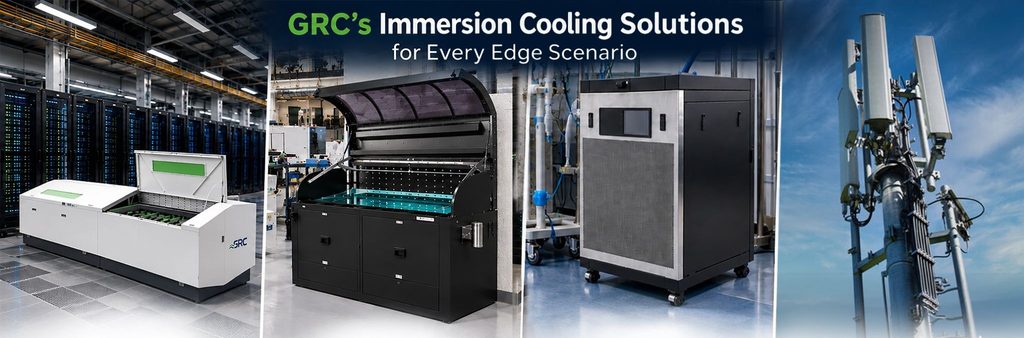
Figure out which solutions are best suited for business. Your specific site constraints and remote monitoring requirements before you commit to a design.
Conclusion
Treat cooling, power, networking, security, compute, remote operations, and heat rejection as one edge system. Select single-phase immersion, where this whole-system design produces a measurable advantage.
The next generation of edge infrastructure will be judged by more than compute performance. It will be judged by its ability to operate in distributed locations, accommodate increasingly demanding workloads, and remain manageable without a permanent team on-site.
That calls for a different approach to cooling design: one that considers thermal performance alongside maintainability, monitoring, serviceability, and lifecycle cost.
For infrastructure leaders building out distributed, high-density edge networks, that difference determines which sites stay reliable and which become a growing line item on next year’s outage report.
Design for the workload. Engineer for the environment. Plan for the absence of on-site staff. Contact GRC to talk through your site requirements, and share your own edge cooling challenges in the comments.
FAQs
1. Is immersion cooling the only option for unmanned edge sites, or can air cooling still work?
Air cooling can still work at low density with regular maintenance access. At high density with no on-site staff, its dependence on filters and fans becomes the main source of risk.
2. Which edge workloads actually need immersion cooling (AI inference, video analytics, 5G/MEC, industrial control)?
AI inference and video analytics tend to need it most, since they concentrate heat in small enclosures. 5G/MEC and industrial control workloads benefit when density or environmental exposure is high.
3. At what rack density does air cooling become impractical for a small edge room or closet?
Many operators see real strain above roughly 10 to 15 kW in a small, unconditioned enclosure, well below the limits of a purpose-built data hall.
4. What are the most common cooling-related failures at unmanned air-cooled edge sites?
Clogged filters, fan failures, and condensate drain blockages are the most frequent causes, often going undetected until temperatures rise or equipment shuts down.
5. Is direct-to-chip liquid cooling enough for a high-density edge site?
Direct-to-chip handles the processor but still needs air cooling for remaining components, which keeps fans and filters in the system. Immersion removes that dependency entirely.
6. Can immersion and air-cooled equipment co-exist at the same edge site?
Yes. Many operators run a hybrid setup, with immersion handling the highest-density equipment while lower-draw gear stays air-cooled.
7. Can GRC immersion systems integrate with my existing DCIM, BMS or NOC tools?
Yes. GRC systems are designed to feed monitoring data into standard DCIM, BMS, and NOC platforms so remote teams retain full visibility.
8. How long does it take to deploy immersion cooling at a new edge site?
Timelines vary by site readiness and enclosure design. GRC can provide a project-specific schedule once site requirements are confirmed.
Bring the Most Efficient Cooling Technology to Your Data Center
To have our representative get in touch with you complete the form below or call: +1.512.692.8003
On: November 3, 2026
Comments: 0