
In today’s rapidly evolving technological landscape, data centers facing increasing demands for performance, efficiency, and sustainability. Traditional air-cooled data centers are struggling to keep up with the escalating heat dissipation requirements of modern computing hardware, and while single-phase immersion cooling offers a highly efficient and effective alternative for today’s data centers, what of the even more powerful (and hot) processors of the future? Immersion Direct Liquid Cooling (iDLC) from GRC emerges as a promising solution to address these challenges. This blog delves into the intricacies of GRC’s iDLC architecture, examining its key components, benefits, and challenges.
Our whitepaper, “Future-proof your data center cooling with GRC’s iDLC technology” explains how iDLC offers an open-loop version of traditional DLC technologies that utilize water/glycol or closed-loop two-phase fluids to deliver highly effective cooling directly to the hottest components of the server.
Understanding iDLC Architecture:
Like traditional single-phase immersion cooling, iDLC involves immersing computing components directly into a non-conductive dielectric liquid. This liquid provides superior heat transfer properties compared to air, efficiently cooling the equipment in its entirely and eliminating the need for supplemental air cooling. But unlike traditional immersion systems, iDLC integrates targeted flow into the overall solution, targeting the systems hottest components (typically the CPUs/GPUs) with additional high-velocity flow to dissipate even more heat.
The iDLC architecture typically consists of the following components:
- Immersion Tank: A sealed container filled with the dielectric liquid, housing the computing hardware.
- Targeted Flow Heat Sinks: Specially designed 1U replacmeents for traditional heat sinks that deliver a pressurized stream of coolant directly to the hottest portions of the immersed server. Once it reaches the processor the coolant cools it and then disperses into the surrounding dielectric fluid.
- Heat Exchanger: A device that transfers the heat absorbed by the liquid to a secondary coolant, such as a water loop or the surrounding air.
- Pump: A circulation pump that moves the liquid within the immersion tank to ensure efficient heat transfer.
- Control System: A system that monitors and regulates various parameters, including liquid temperature, flow rate, and system performance.
Download our whitepaper “Future-proof your data center cooling with GRC’s iDLC technology,” to learn about GRC’s patent -pending iDLC architecture.
The Best Part About iDLC:
- Enhanced Cooling Efficiency: iDLC offers significantly improved heat transfer compared to air cooling, allowing for higher server densities and reduced power consumption. And with the greatly enhanced cooling capabilities unlocked by targeted flow, iDLC delivers nearly unlimited cooling capabilities.
- Improved Reliability: The direct immersion of components eliminates the risk of hot spots and reduces the likelihood of hardware failures.
- Reduced Noise and Vibration: iDLC systems operate at much lower noise levels and generate minimal vibration compared to traditional air-cooled data centers.
- Increased Energy Efficiency: By reducing power consumption and improving overall system efficiency, iDLC can lead to substantial cost savings.
- Environmental Sustainability: iDLC can contribute to a more sustainable data center environment by reducing carbon emissions and water consumption.
iDLC can reduce data center energy consumption by up to 40%. Read our whitepaper “Future-proof your data center cooling with GRC’s iDLC technology” to know how iDLC can help you and your organization.
“The future of data centers lies in immersion cooling. It’s the only way to keep up with the increasing demands of modern computing.”
Conclusion
iDLC architecture represents a significant advancement in data center cooling technology. By offering superior cooling efficiency, reliability, and energy efficiency, iDLC can help data centers meet the growing demands of modern computing while minimizing environmental impact.
To learn more about how GRC’s iDLC technology can revolutionize your data center cooling, download our whitepaper, “Future-proof your data center cooling with GRC’s iDLC technology.”
The relentless growth of data centers has necessitated innovative approaches to thermal management. Traditional air-cooled systems are increasingly challenged to meet the escalating power densities and energy consumption requirements of modern data centers. To address these challenges, two primary cooling technologies have emerged: spot cooling and immersion cooling. Each offers distinct advantages, but their limitations have prompted a search for a hybrid solution. This is where iDLC technology comes into play, combining the strengths of both approaches to deliver superior cooling performance and efficiency. Read our whitepaper, “Future-proof your data center cooling with GRC’s iDLC technology” to know more.
Understanding Spot and Immersion Cooling
As data centers continue to grow in size and complexity, the need for efficient and effective cooling solutions has become increasingly critical. Two primary methods have emerged to address this challenge: spot cooling and immersion cooling. Read our whitepaper, “Future-proof your data center cooling with GRC’s iDLC technology” to know in detail.
Spot Cooling
Spot cooling is a targeted approach to cooling specific areas or components within a data center. It involves circulating chilled fluid through a closed-loop direct-to-chip (DTC) cooling system directly to the hottest components within IT equuipment, such as CPUs, GPUs, memory, and so forth. This method offers precise temperature control, preventing hotspots and ensuring optimal performance, but it also incurs significant cost, introduces tremendous complexity to data center infrastructure, and also creates significant risk of IT equipment damage due to potential conductive fluid leakage.
Immersion Cooling
Immersion cooling is a radically different approach that involves submerging IT equipment in a dielectric liquid. Immersion Cooling submerges IT equipment in a dielectric fluid, which effectively dissipates heat. The liquid directly absorbs heat from the hardware, providing highly efficient cooling and addressing the cooling needs of all IT equipment components – not just the hottest individual components — without requiring inefficient chilled air to do so. This method is particularly effective for high-density computing environments.
Hybrid Cooling: The Best of Both Worlds
As data center demands continue to escalate, a hybrid approach that combines spot cooling and immersion cooling is gaining traction. This strategy leverages the strengths of both methods to create a more efficient and flexible cooling solution. To get assistance on how to choose the right cooling method for your needs, read our whitepaper, “Future-proof your data center cooling with GRC’s iDLC technology”.
Key benefits of hybrid cooling:
- Optimized cooling: By combining targeted spot cooling with the high efficiency of immersion cooling, data centers can achieve optimal thermal management for various workloads.
- Increased flexibility: Hybrid systems can adapt to changing cooling requirements, such as variations in equipment density or power consumption.
- Improved reliability: Combining different cooling methods can provide redundancy and enhance system uptime.
- Cost-effective: While the initial investment might be higher, long-term energy savings and reduced maintenance costs can offset the upfront expenses.
By carefully considering the specific requirements of a data center, organizations can develop a hybrid cooling strategy that maximizes efficiency, reliability, and cost-effectiveness. Learn how by reading our whitepaper, “Future-proof your data center cooling with GRC’s iDLC technology”.
Conclusion
GRC’s iDLC technology offers a promising approach to data center cooling, combining the efficiency of immersion cooling with the precision of spot cooling. Our whitepaper, “Future-proof your data center cooling with GRC’s iDLC technology” explains how iDLC has the potential to reduce energy consumption significantly, improve server performance, and enhance data center sustainability. As iDLC technology continues to evolve, it is poised to play a transformative role in the future of data center thermal management.
To learn more about how GRC Immersion Cooling can revolutionize your data center, download our whitepaper, “Future-proof your data center cooling with GRC’s iDLC technology” now.
Thermal Design Power (TDP) has long been a data center thermal management cornerstone. However, in recent years, its limitations have become increasingly apparent. As chip power densities continue to soar, TDP’s ability to accurately predict cooling requirements has been scrutinized. Download our whitepaper, “Future-Proof Your Data Center Cooling with GRC’s iDLC Technology” to learn more.
The Limitations of TDP
TDP is a simplified metric that represents the average power a processor is expected to consume under specific conditions. However, it fails to capture the dynamic nature of modern workloads and the variability of heat dissipation patterns. This can lead to undercooling or overheating, both of which can have serious consequences for data center operations. Read about the factors influencing TDP along with the chip cooling challenges in our whitepaper, “Future-Proof Your Data Center Cooling with GRC’s iDLC Technology.”
The Impact of TDP on Data Center Cooling
- Inefficient Cooling: Relying solely on TDP can result in inefficient cooling, leading to increased energy consumption and higher operational costs.
- Increased Risk of Failures: Overheating can cause hardware failures, leading to downtime and data loss.
- Limited Performance: Undercooling can restrict processor performance, hindering the ability of data centers to meet the demands of modern applications.
Read about the impact of thermal resistance and TCase on TDP in our whitepaper, “Future-Proof Your Data Center Cooling with GRC’s iDLC Technology.”
Need for a More Comprehensive Approach
To address the limitations of TDP, data centers need to adopt a more comprehensive approach to thermal management. This includes:
- Real-time monitoring: Continuously monitoring the actual power consumption and heat dissipation of individual components.
- Dynamic Cooling: Adjusting cooling capacity in response to changing workloads and environmental conditions.
- Advanced Thermal Modelling: Using sophisticated simulation tools to predict and optimize cooling requirements.
Read more about the comprehensive approach to thermal management along with case studies in our whitepaper, “Future-Proof Your Data Center Cooling with GRC’s iDLC Technology.”
GRC’s iDLC Technology: A Solution to the TDP Challenge
GRC’s Immersion Direct Liquid Cooling (iDLC) technology offers a revolutionary solution to the challenges posed by TDP. iDLC provides precise targeted cooling, ensuring that heat is dissipated effectively where it’s needed most. This eliminates the need for overcooling and allows data centers to operate at optimal efficiency.
GRC’s iDLC technology offers a promising solution to the TDP dilemma. By providing precise targeted cooling, iDLC can help data centers achieve unprecedented levels of thermal efficiency and sustainability. To learn more about how iDLC can help you, read our whitepaper, “Future-Proof Your Data Center Cooling with GRC’s iDLC Technology.”
Conclusion
In conclusion, the limitations of TDP have become increasingly apparent in today’s data-intensive world. By adopting a more comprehensive approach to thermal management, data centers can overcome these challenges and ensure optimal performance, reliability, and efficiency.
To learn more about how iDLC can help you overcome the limitations of TDP and future-proof your data center cooling, download our whitepaper, “Future-Proof Your Data Center Cooling with GRC’s iDLC Technology.”
In today’s data-intensive world, the demand for high-performance processors has skyrocketed. These powerful chips generate significant amounts of heat, making efficient cooling a critical challenge. Traditional cooling methods often involve complex infrastructure and can struggle to keep up with the increasing thermal demands. However, a new approach, known as targeted flow heat sinks, offers a simplified and effective solution. To learn how, read our whitepaper, “Future-Proof Your Data Center Cooling with GRC’s iDLC Technology.”
How Targeted Flow Heat Sinks Work
Targeted flow heat sinks use advanced fluid dynamics to direct coolant precisely to the hottest areas of a processor. This targeted approach ensures that the cooling effort is concentrated where it’s needed most, maximizing efficiency and preventing hotspots. To learn more about how targeted flow heat sinks can benefit your data center, download our whitepaper, “Future-Proof Your Data Center Cooling with GRC’s iDLC Technology.”
Key Benefits of Targeted Flow Heat Sinks:
- Enhanced Performance: By effectively managing heat, targeted flow heat sinks allow processors to operate at higher frequencies and power levels without thermal throttling, improving overall performance.
- Increased Efficiency: The precision of targeted flow reduces the need for excessive cooling, leading to lower energy consumption and reduced operational costs.
- Simplified Design: Compared to traditional cooling solutions, targeted flow heat sinks often have a simpler design, reducing complexity and maintenance requirements.
- Reduced Noise: Targeted flow can minimize the need for fans, leading to a quieter operating environment.
Read detailed benefits in our whitepaper,
“Future-Proof Your Data Center Cooling with GRC’s iDLC Technology.”
GRC’s iDLC Technology
GRC’s Immersion Direct Liquid Cooling (iDLC) technology incorporates targeted flow heat sinks as a key component. iDLC offers a comprehensive solution for cooling high-powered processors, combining the benefits of immersion cooling with the precision of targeted flow. Read more about how iDLC can help you and your organization in our whitepaper, “Future-Proof Your Data Center Cooling with GRC’s iDLC Technology.”
Why Choose iDLC?
- Unparalleled Cooling Efficiency: iDLC’s targeted flow heat sinks provide superior cooling performance, ensuring optimal processor operation.
- Reduced Footprint: Immersion cooling allows for higher server densities, optimizing the use of valuable data center space.
- Enhanced Reliability: iDLC’s closed-loop system protects equipment from contaminants and reduces downtime.
- Sustainability: By improving energy efficiency and reducing the need for traditional cooling infrastructure, iDLC contributes to a more sustainable data center.
Conclusion
To learn more about how iDLC with targeted flow heat sinks can future-proof your data center cooling, download our whitepaper, “Future-Proof Your Data Center Cooling with GRC’s iDLC Technology.”
This comprehensive guide will provide valuable insights into the benefits and applications of iDLC.
By choosing GRC’s iDLC solution, you can ensure that your data center is equipped with the most advanced cooling technology available, enabling you to meet the demands of today’s high-performance computing environments.
In the ever-evolving landscape of data center technology, cooling solutions that can ensure the seamless operation of high-powered processors is top of mind. Conventional air cooling is rapidly losing the battle to cool today’s hottest processors, and while currently available liquid cooling solutions meet the needs of today, what of the even more powerful (and hotter!) processors of tomorrow? Some feel that, without a game-changing breakthrough, single-phase immersion cooling will not be able to meet these challenges, and that only complex, expensive, and potentially leak-prone direct-to-chip solutions will deliver the cooling necessary for chips running 1000W, 2000w, 3000W and more.
But Green Revolution Cooling’s (GRC) Immersed Direct Liquid Cooling (iDLC) architecture is just that breakthrough. This revolutionary approach not only surpasses traditional cooling methods in efficiency and performance but also marks a significant leap toward future-proofing data centers against increasingly dense and power-intensive computing demands. Read on for a closer look at iDLCs architecture and capabilities.
Unveiling iDLC: A Revolutionary Approach to Data Center Cooling
GRC’s innovative iDLC technology redefines the cooling landscape by employing an open-loop system that simplifies the Direct Liquid Cooling (DLC) process. Unlike traditional DLC methods, which rely on complex, costly infrastructures involving water, glycol, or closed-loop two-phase fluids, iDLC utilizes a single supply loop. This ingenious design directly cools the hottest components within a server, such as CPUs and GPUs, through Targeted Flow Heat Sinks (TFHS), efficiently managing heat dissipation without the need for supplementary air cooling.
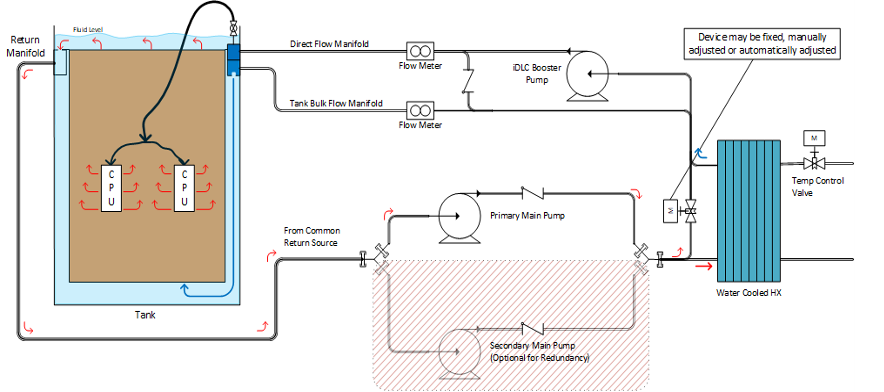
iDLC vs. Traditional Cooling Systems: A Comparative Analysis
The iDLC system by GRC stands in stark contrast to conventional cooling solutions. By enhancing the Coolant Distribution Units (CDUs) and optimizing rack designs, iDLC delivers unparalleled cooling capabilities. The dual flow pressure system allows for targeted cooling of high-heat components while maintaining general rack space cooling. This not only maximizes cooling efficiency but also significantly reduces the infrastructure and operational costs associated with traditional DLC systems.
Optimizing Data Center Efficiency with iDLC’s Dual Flow Pressure System
The architecture of GRC’s iDLC technology is a testament to the sophistication and innovation that the company brings to data center cooling. The system’s dual flow paths ensure that while the bulk flow cools the entire server, a high-pressure directed flow specifically targets processors with TFHS. This method achieves superior cooling performance, addressing the challenge of cooling ultra-high powered processors without the need for oversizing piping and heat transfer systems, thanks to a strategically implemented bypass mechanism.
Future-Proofing Data Centers with GRC’s iDLC Technology
As we move further into the era of big data and AI, the demand for more powerful, efficient, and environmentally friendly data centers continues to grow. GRC’s iDLC technology not only meets these demands but also anticipates the future needs of data center cooling. By embracing iDLC, data center operators and designers can ensure their facilities are equipped to handle the increasing heat loads presented by next-generation servers and processors, making it a crucial step toward sustainable, efficient, and effective data center management.
For those looking to deepen their understanding of this cutting-edge technology and explore the future of data center cooling, downloading our white paper, “Future-Proof Your Data Center Cooling with GRC’s iDLC Technology,” is an essential next step. This comprehensive document offers a deeper dive into the mechanics, benefits, and real-world applications of iDLC, providing valuable insights into how this innovation can transform your data center operations.
In embracing GRC’s iDLC technology, you’re not just optimizing your data center’s cooling efficiency; you’re investing in its future. Explore the potential of iDLC and join us in revolutionizing data center cooling for the next generation of computing.
Download our white paper now to unlock the full potential of your data center with GRC’s iDLC technology.
In the rapidly evolving landscape of data center technology, cooling solutions are undergoing a revolutionary transformation. At the forefront of this change is the innovative Immersion Direct Liquid Cooling (iDLC) technology developed by GRC. This groundbreaking approach promises not only to redefine efficiency and sustainability in data center cooling systems but also to address the increasing thermal management challenges posed by high-density computing environments.
Understanding iDLC: The Next Generation of Cooling
The essence of iDLC technology lies in its sophisticated yet straightforward cooling mechanism. Unlike traditional cooling methods that rely on air or indirect liquid cooling, iDLC utilizes traditional direct liquid immersion techniques coupled with groundbreaking new targeted flow approaches, ensuring that high-performance computing components are cooled more effectively and efficiently. This technology leverages the superior thermal conductivity of liquids over air, providing unparalleled cooling capabilities.
The Mechanics of iDLC: Enhancing Cooling Efficiency
iDLC enhances traditional single-phase immersion cooling systems with its unique ability to deliver two distinct flow pressures within the same cooling infrastructure. This dual-flow pressure system ensures that while the general rack environment is maintained at an optimal temperature, the most heat-generating components receive targeted, high-pressure cooling. This precision in cooling not only maximizes efficiency but also significantly reduces the risk of overheating, even in the most demanding operational scenarios.
Precision Targeted Flow: A Game Changer in Heat Management
What sets iDLC apart is its precision-targeted flow, a feature that meticulously directs cooling to the hottest components of the IT hardware. This is achieved through an innovative Targeted Flow Heat Sink (TFHS) design, which eliminates the need for complex closed-loop systems commonly found in traditional cooling methods. By simplifying the cooling architecture, iDLC not only enhances performance but also minimizes potential leakage risks, a critical concern in data center operations.
Comparing iDLC with Traditional Cooling Methods
Conventional Direct Liquid Cooling (DLC) systems, while effective to a degree, are marred by their complexity, high operational costs, and environmental impact. Conventional DLC systems require intricate closed-loop systems to deliver coolant to the server components and circulate it back to a heat removal system. Besides requiring highly expensive and complex infrastructure to circulate the fluid through the systems, these cooling approaches also introduce significant leakage risks within each and every server. Closed-loop DLC solutions typically use conductive water/glycol or environmentally hazardous two-phase fluids to conduct heat away from the components, which creates the potential for disastrous leaks within each and every sever in the data center. In contrast, iDLC’s open-loop system represents a significant advancement, eliminating the risk of damaging leaks while also offering a more efficient, reliable, and sustainable cooling solution. Plus, by eliminating supplementary air cooling and minimizing infrastructure requirements, iDLC not only reduces operational expenses but also significantly lowers the environmental footprint of data center cooling.
Future-Proofing Data Centers with iDLC Technology
As we peer into the future of data centers, the role of advanced cooling solutions like iDLC becomes increasingly apparent. With the capacity to efficiently manage the heat generated by next-generation chips and high-density servers, iDLC is not merely keeping pace with technological advancements; it’s paving the way for a new era of data center efficiency and reliability. This technology stands as a testament to GRC’s commitment to innovation, offering a sustainable, forward-thinking solution to contemporary cooling challenges.
The Environmental and Operational Benefits of Adopting iDLC
The adoption of iDLC technology carries profound environmental and operational advantages. By significantly reducing the energy consumption associated with cooling, data centers can achieve a lower Power Usage Effectiveness (PUE), translating into substantial cost savings. Furthermore, the use of non-conductive ElectroSafe fluids in iDLC systems minimizes the risk of hardware damage due to leaks, enhancing system reliability and longevity. These benefits, combined with the reduced carbon footprint and operational expenses, make iDLC an attractive option for data centers aiming for sustainability and efficiency.
In conclusion, the advent of iDLC technology by GRC marks a significant milestone in the journey towards more efficient, reliable, and environmentally friendly data center cooling solutions. By addressing the limitations of traditional cooling methods and embracing innovation, iDLC is not just revolutionizing data center cooling; it’s setting new standards for the industry. As we look forward to a future dominated by high-density computing and the ever-growing demand for data, technologies like iDLC will play a pivotal role in ensuring that our data centers are not only capable of meeting these challenges but are doing so in a way that is sustainable for our planet.

Download the White Paper “Future-Proof Your Data Center Cooling with GRC’s iDLC Technology”, and Stay Ahead of the Curve
GRC is your trusted partner, helping you to expertly navigate the complexities of today’s IT cooling challenges and seize the opportunities of tomorrow. Gazing into the future, the role of 1PIC in data center cooling emerges with clarity. Through innovations such as GRC’s iDLC technology, 1PIC systems are not merely keeping pace with escalating thermal densities; they are leading the charge towards a new era characterized by unparalleled data center efficiency, reliability, and environmental sustainability.
This white paper is an essential read for Data Center Operators, Designers, and anyone deeply invested in the Future of Computing, offering:
- Deep insights into the evolution of cooling technologies
- A critical examination of long-standing assumptions
- Revolutionary solutions for sustainable and efficient data center operations they’re paving the way for a new era of data center efficiency, reliability, and environmental sustainability.
Single-phase immersion cooling (1PIC) has emerged as an IT cooling game-changer, delivering superior efficiency, performance, and reliability while driving down the operational expenses. But in the rapidly evolving landscape of data center cooling technologies, 1PIC’s ability to manage the thermal output of next-gen processors exceeding 1000W is both a topic of keen interest and, at times, a subject of speculation. The latest white paper from GRC, “Future-Proof Your Data Center Cooling with GRC’s iDLC Technology,” provides a deep dive into the capabilities, innovations, and future prospects of 1PIC systems, debunking myths, setting new benchmarks, and giving you a sneak-peek at GRC’s latest 1PIC innovation: Immersed Direct Liquid Cooling (iDLC). Here are the top 3 reasons you need to read this white paper today.
Reason 1: Debunking Myths Around 1PIC Limitations
The conversation around the cooling capacity of 1PIC systems has been fraught with speculation, particularly regarding their ability to handle the next wave of high-powered chips. GRC’s recent white paper Liquid Immersion: Cooling 1000W Chips and Above laid these concerns to rest, presenting clear, evidence-based findings that not only can 1PIC systems efficiently manage the heat output of chips exceeding 1000W TDP but are also well-prepared for the future’s even more demanding cooling requirements. But misinformation and FUD remain. Read our latest white paper Future-Proof Your Data Center Cooling with GRC’s iDLC Technology and see how data from Intel dismantles the misconceptions and reaffirms 1PIC’s position as a game-changing solution in IT cooling.
Reason 2: Understanding the Role of TDP in Cooling Technologies
Thermal Design Power (TDP) has long been a crucial metric in determining the cooling requirements of processors. However, TDP alone is not a sufficient measure of a chip’s cooling needs. Relying on only this single point of data oversimplifies a complex challenge and overlooks many intricate factors that affect chip cooling.It discusses the multifaceted aspects of cooling high-heat chips, including server design improvements and the integral role these factors play in enhancing 1PIC’s effectiveness. In “Future-Proof Your Data Center Cooling with GRC’s iDLC Technology” we clearly demonstrate how a more nuanced understanding of TDP and its implications for cooling technology marks a significant advancement in the discourse on data center cooling.
Reason 3: Understanding GRC’s Innovative iDLC Technology Breakthrough
At the heart of “Future-Proof Your Data Center Cooling with GRC’s iDLC Technology” is the introduction of innovative iDLC technology, which promises to propel 1PIC capabilities to new heights. By delivering targeted coolant flow directly to processors, iDLC technology enables virtually unlimited chip cooling capacity, sidestepping the need for more complex and costly cooling solutions. This breakthrough underscores the sophistication and innovative spirit driving the future of immersion cooling technologies.
Download Future-Proof Your Data Center Cooling with GRC’s iDLC Technology Today
Looking ahead, 1PIC’s role in future-proofing data center cooling is clear. And with continuous advancements and the deployment of solutions like GRC’s iDLC technology, 1PIC systems are not just keeping pace with the rising thermal densities of modern processors; they are setting the stage for a new era of efficiency, reliability, and environmental sustainability in data center operations.
For data center operators, designers, and anyone vested in the future of computing, GRC’s latest white paper offers invaluable insights into the evolving realm of cooling technologies, challenges long-held assumptions, presents groundbreaking solutions, and charts a course for the sustainable, efficient, and reliable operation of data centers in the face of increasing thermal demands.
Download “Future-Proof Your Data Center Cooling with GRC’s iDLC Technology” today, and stay ahead of the curve in data center cooling technologies with GRC — your partner in navigating the complexities of today’s IT cooling challenges and tomorrow’s opportunities.
In the era of rapid technological advancement, artificial intelligence (AI) has become a cornerstone of innovation, driving the need for more powerful and efficient data centers. As AI deployments escalate, so does their power consumption and impact on the environment. To name just two recent examples, Google’s carbon emissions surge nearly 50% due to AI energy demand, and Microsoft reported a 29% increase in carbon emmissions — fueled by the AI boom — in 2023. Simply put, data centers must embrace sustainable solutions to manage the immense heat generated by these high-powered computing environments. In this blog post we’ll explore delves single-phase immersion cooling can revolutionize AI data centers, offering a sustainable and efficient solution that significantly reduces their carbon footprint.
The Rising Demand for Sustainable Data Center Solutions
The digital age is upon us, with AI at the forefront of this revolution. Data centers, the backbone of this technological era, are under increasing pressure to manage the heat generated by the dense computing power required for AI operations. Traditional cooling methods, such as air cooling or direct-to-chip liquid cooling supplemented by chilled air, are becoming insufficient and environmentally unsustainable. This inefficiency has led to a critical need for sustainable data center solutions that can handle the thermal demands of AI without exacerbating environmental issues.
Understanding Liquid Immersion Cooling Technology
Single-phase liquid immersion cooling represents a paradigm shift in data center cooling strategies. This technique involves submerging electronic components directly into a non-conductive liquid, which absorbs and dissipates heat more efficiently than air. Unlike traditional cooling methods, single-phase liquid immersion cooling eliminates the need for costly and energy-intensive air chilling infrastructure, paving the way for a more sustainable approach to managing data center temperatures.
Reducing Carbon Footprints with Advanced Cooling Methods
Adopting single-phase liquid immersion cooling can significantly reduce the carbon footprint of data centers. By doing away with air cooling infrastructure, data centers can decrease their power consumption and, consequently, their environmental impact. This advanced cooling method not only addresses the thermal management challenges posed by high-performance computing but also aligns with global efforts to combat climate change through reduced greenhouse gas emissions. For a closer look at how immersion cooling’s thermal capabilities help you stay ahead of the data center cooling curve check out our white paper “Liquid Immersion: Cooling 1000W Chips and Above.
The Economic and Environmental Benefits of Going Green
The transition to single-phase liquid immersion cooling offers compelling economic and environmental benefits. Economically, it reduces operational costs by lowering energy consumption and increasing equipment lifespan through better thermal management. Environmentally, it minimizes carbon emissions and mitigates the data center industry’s impact on global warming. By embracing this green technology, data centers can achieve sustainability goals while optimizing their operational efficiency.
Future-Proofing Data Centers with Immersion Cooling
As the demand for AI and high-performance computing continues to grow, data centers must evolve to meet these challenges sustainably. Single-phase liquid immersion cooling not only meets the current needs of thermal management but is also scalable, offering a solution that can adapt to the increasing power densities of future technologies. By investing in this innovative cooling method, data centers can future-proof their operations, ensuring they remain competitive and sustainable in the years to come.
Embracing the Green Revolution in AI Data Centers with GRC
The AI revolution is reshaping the landscape of data centers, pushing the limits of traditional cooling methods and prompting a shift towards more sustainable practices. Single-phase liquid immersion cooling from GRC stands at the forefront of this green revolution, offering a viable solution that decreases carbon footprints while enhancing operational efficiency. As we move forward, the adoption of this technology will be pivotal for data centers aiming to balance the demands of high-performance computing with environmental sustainability.
Cutting-edge immersion cooling solutions from GRC effortlessly meet the demands of high-performance, high-density deployments. It delivers superior cooling capabilities while significantly reducing power consumption compared to traditional air cooling systems. Additionally, GRC’s simplified single-phase immersion cooling system eliminates the need for complex components like chillers, air handlers, and humidity control systems, reducing operational and maintenance costs. This also frees up power that can then be reallocated to expand compute capabilities. Contact GRC today to discover how our innovative immersion cooling technology can power up and cool down your systems more efficiently.
Artificial intelligence (AI) technology is reshaping several industries. AI workloads tackle large datasets and deliver real-time results with unprecedented speed and accuracy. But AI deployment has one major drawback: it consumes a lot of power.
One study suggests AI could eat up anywhere from 85 to 134 terawatt hours per year by 2027. For context, that’s roughly the same average annual energy demand as the Netherlands. The average data center simply isn’t equipped to handle the heat generated by that load. Yet companies will continue to embrace AI technology to stay competitive.
So, what can data centers do differently to help businesses adapt to the demands of AI technology? The answer lies in immersion cooling.
For years, we’ve known how immersion cooling can help increase data center density, reduce water use, and improve power usage effectiveness (PUE). Now, there’s another tangible benefit: it makes AI deployment easier and more cost-effective. We explore how it can give your data center an edge.
Higher Performance to the Systems
Let’s look at the simple science behind immersion cooling. Because liquid absorbs heat better than air, submerging racks into a liquid cools them faster than blasting air conditioners. Immersion cooling uses a special dielectric liquid such as mineral oil, which conducts heat but not electricity.
Research shows that immersion cooling liquid’s heat capacity by volume is 1,120–1,400 times greater than air. This means liquid transfers heat out of critical components at a much faster rate. Critical AI systems can then run complex algorithms without the threat of overheating. In fact, a 2023 study found that switching to immersion cooling improves computing efficiency by 96%.
AI is a fast-paced world. Calculations are made in milliseconds, so high performance is paramount. Businesses are constantly experimenting with AI to see how they can push the boundaries of their services and products. The last thing they want is a disruption like thermal throttling, where processors reduce their speeds to prevent damage. This decreases both performance and AI responsiveness.
With immersion cooling, hardware components can easily operate within optimal temperature ranges. It can also sustain peak performance levels over extended periods. This ensures faster data processing, more complex computations, and smoother AI deployment performance.
Ensuring AI Deployment Operates at Peak Efficiency
One significant way immersion cooling adds to your bottom line is through operational efficiency. For one thing, there are fewer moving parts and components. No big air conditioning units that consume a lot of energy; just tanks filled with the cooling liquid. What’s more, your center will need less frequent maintenance and servicing, which reduces downtime.
Immersion cooling also protects servers from dust and dirt and helps to prevent mechanical failure. It minimizes several operational issues as well, such as oxidation, corrosion, and general wear and tear. As a result, you can create an ideal environment that can handle the load of AI and high-powered computing (HPC).
AI deployment within data centers enables you to boost operational efficiency even more. For instance:
- AI software toggles the use of server racks in real time to distribute the power load evenly.
- It allocates network bandwidth and data storage based on processing demands.
- AI can help with capacity planning and the timely maintenance of processors.
Higher Density, Smaller Footprint
In traditional air cooling, server racks require a lot of space to allow optimal airflow. But with immersion cooling, you can build denser racks and optimize your data center as you see fit. An air-cooled data center has a maximum power density per rack of 50 KW. By contrast, immersion-cooled centers provide up to 250 KW of power density per rack. This is a five-time increase in density.

Each cooling tank can hold as many servers as multiple server racks. And again, because you don’t have to invest in bulky air conditioning units and complicated ductwork, you’ll free up valuable floor space for more servers. This makes immersion cooling an agile and scalable solution for AI deployment. Even adding new servers won’t increase your heat load.
Immersion cooling is also a sustainable solution. Combined, data centers consumer over 205 terawatt hours of electricity each year—more than countries like Denmark and Ireland. One report says the global tech industry will consume as much as one-fifth of worldwide energy by the 2030s. Some industries run data-intensive operations around the clock. ChatGPT alone may be using more than half a million kilowatt hours of electricity every day.
The good news is that immersion cooling offers an excellent solution to this challenge. These data centers use about 50% less energy than their conventional air-cooled counterparts. This makes AI deployment more sustainable in the long term.
It also trims 10–20% off your electrical costs and reduces your carbon footprint. Your energy bills will go down and stay down, which directly improves your bottom line.
Cool Your AI Deployment With GRC
Thanks to advancing technologies, immersion cooling has become more scalable, less costly, and easier to maintain. The immersion cooling industry is growing at a staggering rate of 24.42%, and Green Revolution Cooling (GRC) is at its forefront. Here’s why you should make the switch:
- Deploy high-density racks to pack greater computing power into smaller spaces.
- Meet the ever-growing demand for AI in every industry.
- Be able to colocate data centers in urban areas where real estate is at a premium.
- Cut your electricity and water usage in half.
- Use AI within your data center to bring more operational efficiency.
In short, immersion cooling solves many of the pressing logistical, environmental, and performance-related issues that come with AI deployment. Most importantly, it reduces downtime and makes your data center more reliable.
Our patented immersion cooling system can easily process up to three times the normal power usage demand. It can also provide around 15 times the cooling capacity of air-cooling systems. We use single-phase immersion cooling tanks that keep your systems from overheating. Contact us today to learn how immersion cooling can be a game changer for your company’s financial health.
From the arctic to the desert, data centers often operate in some pretty extreme environments. In these high-demand settings, servers need innovative cooling and maintenance solutions to enhance efficiency and reduce downtime. Immersion cooling system technology stands ready to address these challenges.
In this cutting-edge approach, hardware is submerged in a non-conductive liquid. By harnessing immersion technology, data centers can meet the increasing demands for data processing and storage. It also paves the way for more sustainable and efficient operations in extreme environments.
Let’s explore what makes liquid cooling technology so ideal for data centers in challenging locations.
The Core Advantages of Immersion Cooling in Hostile Climates
In hostile climates, traditional air-cooling systems can struggle to maintain optimal server temperatures. Immersion cooling presents several key advantages for these data centers.
For instance, immersion cooling significantly enhances cooling efficiency. A dielectric fluid absorbs heat far better than air. By submerging servers directly into this fluid, heat is removed more effectively and uniformly. This method ensures that even under extreme external temperatures, the critical components remain at stable, lower temperatures. It reduces the risk of overheating and improves overall hardware performance and longevity.

Immersion technology also offers robust protection against environmental factors. In areas prone to dust, humidity, or corrosive pollutants, traditional cooling methods often falter. These contaminants can damage sensitive server components.
By contrast, immersion cooling seals the hardware away from the external environment, protecting it from such particles and gases. This enhances the durability and reliability of the data center’s equipment. It also reduces the frequency and necessity of maintenance and cleaning.
Overall, immersion cooling is a game changer for compute deployed in extreme environments. It ensures operational efficiency, reduces energy consumption, and protects valuable equipment from the harsh elements prevalent in such regions. These benefits are crucial to maintain the continuous, uninterrupted operation of critical data infrastructure worldwide.
Enhancing Durability: Immersion Technology’s Role in Equipment Longevity
Immersion cooling technology can extend the longevity of equipment in extreme environments by mitigating two of the main culprits of wear and tear: heat and dust. The dielectric fluid efficiently dissipates heat away from servers and other critical components.
This controlled temperature environment also prevents the thermal stress that traditionally leads electric components to age faster or fail altogether. In addition, the immersion environment is inherently sealed. It shields sensitive equipment from dust, debris, and other particulate contaminants that can erode connections and corrode surfaces over time.
Such protection significantly reduces the frequency of hardware failures and maintenance needs. It also extends the operational lifespan of the equipment. As a result, data centers that employ immersion cooling benefit from lower operational costs and increased reliability. It’s an indispensable technology in maintaining robust and durable systems in harsh conditions.
Beyond Cooling: Additional Benefits of Immersion Technology in Extreme Settings
Beyond its primary function of cooling, immersion technology offers several additional benefits that make it particularly ideal for extreme settings. One significant advantage is the improvement in performance.
The consistent and efficient cooling provided by immersion reduces thermal throttling. Servers can therefore operate at peak efficiency without overheating, which enhances processing power and speed.
What’s more, immersion technology simplifies maintenance. Again, the sealed immersion environment protects components from dust, moisture, and other contaminants that can trigger frequent cleaning and repairs. This reduction in physical wear and tear extends hardware life and decreases maintenance costs.

Finally, immersion cooling systems are more space-efficient than traditional air-cooled systems. They eliminate the need for bulky air conditioning units and complex ductwork. The result is a more compact design that maximizes space utilization within data centers. These space-saving benefits are crucial in environments where physical space is at a premium or construction conditions are challenging.
Sustainable Solutions: Immersion Technology as a Green Initiative
Immersion technology stands out as a sustainable solution in extreme environments. It significantly reduces both energy consumption and environmental impact. Because dielectric liquids have much higher heat absorption rates than air, immersion cooling systems dramatically improve the energy efficiency of cooling processes.
This heightened efficiency lowers the energy usage needed for cooling, which is one of the largest power-consuming tasks in data centers. The reduction in energy consumption not only cuts operational costs but also decreases the carbon footprint of these facilities.
Because immersion cooling protects equipment from environmental contaminants and temperature fluctuations, it extends the lifespan of hardware. This longevity reduces the frequency of manufacturing new components and lowers the waste associated with disposing of old equipment.
What’s more, the fluids used in immersion cooling can often be recycled and reused, which further minimizes the environmental impact. Overall, immersion technology represents a powerful way to advance sustainability in data center operations within extreme environments.
Sourcing Immersion Cooling Solutions
Immersion cooling technology is reshaping how data centers approach cooling, performance, and sustainability in extreme environments. It can significantly reduce energy consumption, protect equipment from harsh elements, reduce maintenance needs, and decrease operational costs.
Green Revolution Cooling (GRC) is a leader in the cooling industry. We harness these benefits through innovative immersion cooling systems that are tailored to meet diverse business needs.
Our solutions offer enhanced cooling efficiency and contribute to a substantial decrease in energy usage. This echoes the growing demand for environmentally sustainable technologies. By providing systems that maintain a sealed, contaminant-free environment, GRC ensures critical data center equipment operates under optimal conditions. It extends hardware lifespans and improves overall performance.
For businesses that want to innovate their data center operations through immersion technology, GRC offers a path forward. Our expertise and proven solutions in immersion cooling can help you achieve higher efficiency, greater reliability, and a reduced environmental impact. Contact us today to learn more about how we can help you improve your operations and advance your sustainability.