
Increased computing power and performance demands, combined with technological advancements such as artificial intelligence (AI), Internet of Things (IoT), and machine learning (ML), have resulted in rising temperatures within data center infrastructure and IT equipment. More compute means more power, more power means more heat, more heat needs more cooling which consumes yet more power, and the cycle continues.
Given the inefficiency of traditional air cooling systems — and the combination of sustainability-minded design goals, governmental regulation, rising power costs, and the technological demands to cool cutting-edge CPUs and GPUs — the need for more efficient and less power-hungry cooling systems is clear.
Is immersion cooling the future of high-performance computing? If one looks at the impressive forecasts, it certainly appears so. The immersion cooling market is projected to grow from $243 million this year to $700 million by 2026. Driving these phenomenal growth projections are an ever-increasing number of data centers and the rising need for cost-effective and eco-friendly cooling solutions.
Immersion cooling is the hot new thing in computer cooling with several key advantages that are winning over more and more converts. It can handle far greater power densities, it operates cleanly and quietly, and it costs much less than traditional air cooling. All of these advantages have additional value for high-performance computing, which pushes processors and budgets to their limits.
Research shows that the high-performance computing segment makes up the second-largest share in the immersion cooling market. The large share is explained by the fact that high-performance computing (HPC) is gaining traction across many different industries with enterprises looking to scale up complex applications. Researchers, however, point to increased retrofitting costs of existing infrastructure, coupled with the requirement for new specialized infrastructure, as possible restraints for the growth of the immersion cooling market.
What Is Immersion Cooling?
Immersion cooling is, as the name suggests, dropping temperatures through the submersion of components in liquid. Instead of blowing cool air over your electronic parts, you submerge the entire system into a dielectric liquid.
Much like a plastic layer around a cable does not conduct electricity, dielectric fluid also does not conduct electricity. When a current reaches the liquid, it does not travel through the liquid. This allows the computer equipment to function even when submerged.
Some dielectric liquids are sourced naturally, such as mineral or biological oils, while others are engineered. These liquids work tremendously better at conveying heat away from the heat source when compared with air —1,200x or more!
Dielectric liquids are typically divided into two types: single-phase liquids which are designed to circulate around the equipment and then through a heat exchanger, and two-phase liquids that boil at low temperatures to dissipate the heat even more rapidly. We’ll get into the pros and cons of these two approaches later.
Immersion cooling can employ several different configurations. For instance, the electronics can be fully contained within closed systems for each computer, or within a single large vessel that holds multiple machines, or in some combination. Each arrangement requires different components to distribute the heat.
One can describe the immersion cooling process as a revolution in evolution. It is an evolutionary advance in applying immersion cooling — which has been around a long time and used in many industries and applications — to using new fluids and systems appropriate for use with modern servers and IT. This revolutionary technology marks a rapid shift to sustainable, cost-efficient data center cooling solutions.
Given the demand for green IT to address rising costs and climate change-driven policy, liquid immersion cooling is poised to become a staple of data centers, rendering air cooling systems redundant. Immersion cooling offers many unique advantages that include yielding an extremely efficient operation that slashes electrical costs while enabling “green” computing and a quieter work environment.
In addition, immersion cooling eliminates many of the moving parts associated with air cooling. The liquid approach also means a smaller real estate footprint, offers a much lower total cost of ownership (TCO) and is substantially easier to maintain.
Tech giants, including Intel, Facebook, and Google, have put their weight behind liquid immersion cooling, while industry and government are working to make this technology standard. If all of these advantages have you thinking: this sounds like the future of data centers, then you are on the right track.
Single-Phase Immersion Cooling vs. Two-Phase Immersion Cooling
During single-phase, immersion cooling, the equipment is immersed in a thermally conductive dielectric liquid — typically a synthetic hydrocarbon. The facility’s available coolant can be used to dissipate heat from the server setup. The coolant always remains in a liquid state. The technique uses ‘open baths’ since the coolant is non-evaporative.
With two-phase immersion, as in the single-phase approach, servers and other equipment are also immersed in a thermally conductive dielectric liquid. The liquid circulates to make direct contact with hot components. The liquid evaporates off the electronics into a gas (the second phase) to remove heat, then re-condenses back into a liquid. In two-phase immersion, the dielectric liquids in use are fluorocarbons with low boiling points. The electronics cook off the coolant into a vapor, which then condenses on a heat exchanging coil to return at a lower temperature to the basin.
Those same low boiling points also make two-phase liquids highly evaporative. As such, these systems must be sealed with the liquid inside to prevent evaporative loss of the fluid. This makes two-phase systems more complex and less practical than single-phase immersion cooling.
Both immersion approaches involve drawing the heat out of the components through liquid instead of air. The difference is essentially in whether that cooling liquid undergoes an intermediate vapor stage. The phase change from liquid to gas removes heat in two-phase cooling, while one-phase cooling instead dumps the heat into another outlet through liquid only.
What Are Some Use Cases for Immersion Cooling?
Immersion cooling has already and impressively racked up several use cases where it has ably demonstrated its value. Many of the applications involve high-density computing, settings in which it has proven challenging to cool equipment sufficiently with traditional air cooling.
Supercomputing
Supercomputing for scientific or engineering activities places extreme demands on computers within a small volume, requiring huge cooling capacity. This has made supercomputing one of the main drivers of immersion cooling adoption.
High-performance computing (HPC) requires intensive power for the processors themselves as well as for cooling. Immersion solutions like GRC’s ICEraQ One can drastically decrease energy consumption – removing 10-20% of server use and 95% of cooling use. This enables innovative applications as well as makes the physical requirements more manageable.
Supercomputing centers are often loud enough to require hearing protection, but immerison cooling operates silently. It also cuts around half of the infrastructure costs, saving more money for the servers themselves.
Immersion cooling increases the number of operations per second, per watt, and per dollar, yielding more powerful supercomputers. Not only are they faster, these supercomputers are also more sustainable thanks to their decreased resource use.
Enterprise HPC
Businesses make use of high-performance computers, as do scientific and other institutions. For enterprise HPC, immersion cooling offers greater efficiency and cost savings. As with other applications of immersion cooling, this results in smaller footprints and lower latency, plus more reliability.
It’s tough for businesses to anticipate their computing needs. Immersion cooling makes this easier, given that the modular units allow for constructing what is needed when needed. Gone are the days of having to commit to far larger buildouts than what’s required.
GRC’s ICEraQ Quad liquid immersion cooling solutions cost half as much as other alternatives. For private or public clouds and other use cases, you can eliminate nearly all cooling costs, as well as maintenance and operating expenses.

AI and Machine Learning
Artificial intelligence, including the statistical approach called machine learning, requires relatively intensive computing resources. These systems often use high-density CPUs and GPUs, as well as custom chips like Google’s TPUs. Cooling all of these processors has proven challenging for air cooling systems. Liquid immersion, however, handles the heat, literally!
AI does numerous parallel computations with powerful processors, pulling several times more electricity than average. These draw heavily on the electrical equipment and generate heat. Resultantly, AI data centers have become larger to accommodate these needs.
The real-time processing of AI pushes processors to the limit. Immersion cooling raises these limits, thus enabling faster, smarter computing. Immersion in a dielectric fluid provides practically unlimited cooling. This lets artificial intelligence expand to run on as much hardware as necessary, including new GPGPUs.
Data mining, another computing-intensive application of statistics and pattern detection, also necessitates the need for these data centers to use liquid immersion cooling. Along with analytics, fraud detection, and other low-latency functions, these operations make considerable use of power-hungry hardware accelerators.
Blockchain and Cryptocurrency
Cryptocurrency has taken off over the last few years, turning into one of the core drivers of immersion cooling. Crypto applications often employ dedicated hardware like GPUs and ASICs that require considerable cooling.
Mining cryptocurrency requires massive computational resources. As such, this endeavor has worked alongside supercomputing as a key motivation for using liquid immersion cooling. Efficient heat management technology allows these intense processes to run smoothly. Crypto users and admins want to extract as much performance as they can out of their hardware. Immersion cooling allows for safe overclocking. The greater efficiency yields higher profits.
Blockchain is rapidly expanding into areas other than cryptocurrency. Expansive networks to verify data require heavy computation. The complex mathematical calculations produce heat that dissipates more efficiently with immersion cooling. To generate a profit, blockchain applications need to minimize power use wherever they operate. Speed matters, given the rapid ups and downs of cryptocurrencies. GRC’s immersion cooling addresses these needs. You can use them anywhere you want, however remote.
GRC even offers a custom blockchain rig in a container, the HashTank. Complete with networking, remote monitoring, electrical infrastructure, and fire detection, these extremely efficient mining centers can handle 648 kilowatts of processing. You can also install the HashRaQ in an existing data facility.
High-Frequency Trading
As more capable computers have become available, the finance industry has put them to use for low-latency transactions. Huge amounts of money ride on mere milliseconds. Thus the cooling capacity and processing enhancements of immersion technology are a good fit.
The speed pressures of high-frequency trading require data centers near where they trade. This puts a premium on equipment density, which along with the exacting computational criteria makes cooling efficiency downright necessary. Also, the data centers must operate within limited power and space envelopes.
Fortunately, immersion cooling can deliver more than enough capacity right in busy metro areas. Even without revamping a site, you can install a full-fledged data center where you need it. The powerful processors in use for HFT can then glide through operations with minimal cooling overheads.
Why Should You Go For Immersion Cooling?
There are several motivations for using immersion cooling, which apply to different organizations. These reasons vary and could include handling greater power densities than previous cooling technologies support; decreasing costs for a data center; increasing energy efficiency.
You Need To Expand Beyond Your Power Envelope
In the data economy, IT resources often push beyond the available power. For cases like these, you can use liquid immersion cooling to cut down on your power consumption and increase your computing capacity.
As you gradually replace your older air-cooled systems, you’ll see electricity use (and the accompanying costs) drop. The immersion cooling units use less power, and they also make the servers themselves run more efficiently. You can fit in double the computers, which may even remove the need to build another data center.
It’s the extreme energy efficiency of immersion cooling that allows more processors within the same power envelope. Data centers that have maxed out their power yet need more computing should consider immersion cooling. It makes more sense than bringing in additional power.
An oil and gas business, for instance, had an obsolete data center that could no longer support its functions effectively, as it burned through more power on cooling than on computing. With ICEraQ immersion cooling, however, they seamlessly decreased their use of the power envelope, revitalizing the facility with double the servers within weeks.
You Face High Capital Expenses for a New Data Center
The upfront costs to build a traditional air-cooled data center are high. From building design through the installation of air handlers and chillers, the costs quickly add up. Raised floors and other requirements can make a new data center unaffordable. By eliminating the need for all the air handling infrastructure of the traditional air-cooled data center, immersion cooling can cut your capital expenses in half.
With immersion cooling, you have a smaller footprint so you can also decrease capital expenditures on building the data center itself. A smaller building will suffice, and you don’t face the same initial costs on generators and other electrical equipment. Instead, you can build a smaller data center with only the cooling capacity that you need now.
Traditional cooling necessitates computational fluid dynamics (CFD) analysis, a difficult task to prevent the data center from overheating. It also imposes other preventive measures, including construction and engineering work. The mounting costs can undermine the very profitability of the endeavor. Liquid immersion cooling minimizes the amount of capital necessary for preparing the structure. Instead, the investment can go into IT resources that directly contribute to the organization.
Air cooling is constrained to around 15 kilowatts per rack, an order of magnitude less than immersion cooling. This forces the development of larger, costlier data centers, which can become prohibitively expensive. Liquid immersion solutions, on the other hand, with their lower absolute cost and their modularity enabling gradual deployments, sidestep the tricky situation of high CAPEX.
If You Are Looking for Extreme Energy Efficiency
Energy efficiency, the ultimate determinant of data center functionality, is much higher with immersion cooling than with air. Many of the server applications now gaining steam are GPU-intensive, pressing the limits of available power. Data centers are on track to use a fifth of the world’s electricity production in the next few years.
Liquid immersion can cut energy use in half. This drops the cooling cost from 70% to 3% of the power requirement for processing! Organizations in areas with large energy costs are already relying on GRC’s efficient cooling solutions. Examples include the greenest supercomputer on the planet in Japan, along with geoscience businesses in Australia and the US. The growing trend towards green data centers and sustainable computing will only make this motivation to use liquid immersion cooling more compelling.
Today’s uses of data exceed what air cooling was designed to support, and tomorrow’s uses will need even more energy. Liquid immersion drastically ups the efficiency of data centers, opening new avenues of possibility.
The more efficient use of power saves money, increases server density, and protects the environment’s scarce resources. It also gives you flexibility in where and when you add capacity. As business and IT increasingly progress together, having complete control of your energy use can propel your profits.
This need for more efficient power use applies not only at the level of the data center but also at the level of the rack. By packing potentially ten times as many servers into the same volume, each rack becomes a super-dense computer trove.
Liquid Immersion: Myths vs Facts
Public perception of liquid immersion cooling has not yet caught up with the development of the technology itself. Numerous myths surround the technology, clouding decisions as to which cooling solution to deploy. The right information can assist you in finding a safe and cost-effective system.
It’s a New and Unproven Technology
Liquid immersion cooling has extensively been rolled out across a range of contexts including a number of the most intensive computing facilities on the planet. Some of the main telecoms, government agencies, and supercomputing and search facilities use immersion cooling. The last decade, for example, has seen installations by the United States Air Force (USAF), the National Security Agency (NSA), and several multinational oil and gas enterprises.
The cooling technology has worked consistently for years, totaling millions of hours of server activity. Users have found liquid immersion cooling extremely reliable, considerably exceeding air cooling setups. After numerous iterations of product development, this is now a well-established technology.
Liquid immersion technology has expanded to encompass multiple products for a range of high-performance needs. For instance, GRC’s ICEraQ is ideal for use with artificial intelligence, enterprise HPC, and cloud services.
Research and testing on immersion cooling go back decades even before modern commercial applications of the technology. It now supports servers from Dell, HP, IBM, and practically any other manufacturer. This technology has undergone exhaustive testing and it performs far better than air cooling in even the most demanding use cases.
Liquid Immersion Is More Expensive Than Traditional Cooling
The opposite is true. Liquid immersion is actually much less expensive than traditional cooling. Organizations have found that they spend around half as much on data centers and energy with liquid solutions, saving literally millions of dollars on deployments. Still not convinced? Try this TCO calculator.
With liquid immersion, even the servers themselves cost less to run. Bathed in cooling oil, they don’t require inefficient fans. This cuts down the cost of running the servers by about a fifth, in addition to the financial savings from the infrastructure.
The savings start at installation with the lower initial requirements, then continue to accrue throughout the operation of the cooling system. Both CAPEX and OPEX are noticeably less with liquid. The cooling costs are 95% lower than with air. Myth busted!
Liquid Immersion Cooling Is a Complex Solution
While liquid immersion differs from traditional air systems, it’s mechanically far simpler – not more complex. For example, GRC’s immersion cooling systems have almost no moving parts, which simplifies maintenance immensely in comparison to high-wear air cooling. An annual filter change for the liquid replaces the extensive service requirements of air coolers.
Moreover, the elegant design of liquid immersion systems gives technicians easy access to servers for hot swapping and the like. It also makes the entire data center simpler, without the need for hot and cold aisles, raised floors, chiller plants, humidity controls, air handlers, and much of the electrical equipment necessary for air cooling. Plus you can install it practically anywhere.
The technology of liquid immersion is not complex, it basically involves pumping a liquid around. The parts are straightforward. Use of the system is also easy, as it connects directly with existing material including servers, power, and networking. This solution displaces the hugely complex components and supporting infrastructure of traditional air cooling.
Liquid immersion is such a simple solution that you can deploy a complete server setup in mere weeks, with installation measured in days. It’s reliable and remote monitoring is a snap. Cooling with liquid results in efficiency as well as simplicity.
The Coolant Used is Highly Expensive
In single-phase liquid immersion cooling, the kind of immersion that has become commercially successful, you use an inexpensive fluid, like GRC ElectroSafe. This substance remains within the cooling system throughout the years of its operation.
While ElectroSafe has 1,200 times the cooling ability of air, this does not result in bigger costs. On the contrary, the entire system costs far less than air cooling. There are several variants of the coolant that you can select from, all of which are safe, affordable, and widely available.
While there are two-phase coolants that cost more, you don’t need those for immersion cooling. Instead, the inexpensive single-phase coolant fits easily into the much lower total cost of ownership: half as much as air cooling. Also, unlike two-phase fluids, most single-phase fluids are non-evaporative and designed to be used continuously for 15 or more years. In summary, the coolant for liquid systems is not highly expensive, particularly when the cooling solution uses a single-phase liquid.
It’s Hard to Integrate With Legacy Data Centers
Immersion cooling works surprisingly well with legacy data centers. You can upgrade an older data center with its existing infrastructure. You can even incorporate an area of high-performance liquid-cooled servers within an operational air-cooled facility.
Installation of immersion cooling systems is quite easy, so you can fit it into your legacy data centers as necessary. Regardless of whether you have raised floors, concrete floors, or even unused rooms or loading docks, adding on a immersion cooling system is seamless.
The adaptable technology allows you to make more efficient use of older data centers’ space and power. Whether you partially or entirely retrofit the data center, you can then support new workloads including high-performance computing. Modular coolers like the ICEraQ can accommodate legacy facilities easily.
Air Cooling vs Liquid Immersion Cooling
While both air cooling and liquid immersion cooling use a medium (air or liquid) to ship heat away from components, they differ immensely in how they function mechanically, how cost-effective they are, and how much computational capacity they can support. They also differ in terms of where they can operate and how susceptible they are to environmental hazards.
Mechanism
Air cooling pushes air from outside through a series of equipment including air handlers and computer room air conditioning (CRAC). The cooled air goes through a raised floor into a cold aisle, then through the servers where it siphons off heat, then into a hot aisle. From there the air returns to the air handlers to restart its journey.
Liquid immersion cooling, in contrast, entails directly dunking the servers in a fluid that transfers heat over a thousand times more effectively than does air. This liquid circulates through a cooling distribution unit (CDU) that dissipates the heat through a heat exchanger, returning the liquid to the start.
Air cooling pushes heat through complex mechanisms that cost a lot in money and space. This contrasts against immersion in a non-evaporative liquid. As the heat in a immersion cooling system is handled by the facility’s coolant, the waste heat can even be reused to warm the building’s water and air.
The liquid immersion approach has a simpler mechanism, which requires only three moving parts. This drastically aids all aspects of running a data center. It’s easier to build a data center for immersion cooling, costs less, equipment breaks down less often, and supports greater computational density.
Cost
When we compare the costs of air versus immersion cooling, we must consider the initial costs (CAPEX) as well as the ongoing costs (OPEX), the two different components of total costs (TCO). Also, for a fair comparison, we should include not only the cooling devices themselves but also any necessary accessories.
The far greater efficiency of liquid makes it capable of cooling more servers in a smaller space at a lower cost. It also decreases the complexity of the machinery, making maintenance easier. Air cooling costs around two times as much upfront due to all of the external cooling equipment, space, battery backups, and raised floors.
Even after construction, air costs more than liquid. This again derives from liquid’s more efficient heat transfer properties. Fans draw power continuously, while refrigeration also drains power. The bottom line: air adds a heavy toll to data center operational costs. Immersion drops 90% of the cooling costs, a good part of the total data center energy budget.
Performance
When it comes to performance, air cooling tops out at around 30 kilowatts per rack, with a massive loss of efficiency at around half that. By contrast, immersion cooling can handle over 100 kilowatts per rack, in some cases twice that.
Modern HPC loads extend beyond the capacities of air cooling, and this trend will only intensify. Liquid solutions have ample capacity and will become necessary for data centers in the coming years.
Data centers increasingly are running energy-intensive loads like artificial intelligence and crypto. These often employ dedicated processors that are multiplying in power consumption. As such, we need the order-of-magnitude gains of immersion cooling.
Location
Air cooling restricts data centers to certain locations where air filtration and other infrastructure will fit, while immersion cooling has fewer requirements and can be installed anywhere. As edge computing becomes the norm, this advantage will make immersion cooling more compelling. Reliable operation is already making immersion cooling popular for out-of-the-way installations.
Humidity, temperature, and other factors can affect the performance and reliability of cooling systems. Air cooling uses outside air, so it loses much of its efficacy in warm locations, where many data centers are situated. On the other hand, immersion cooling does not have this dependency. It works with a coolant that remains potent regardless of outside weather conditions.
Air cooling also imposes location constraints from the additional size necessary for spacing out servers to dissipate heat. With immersion cooling, you can pack servers much more closely together, without the need for hot and cold aisles or anxieties over hot spots.
Immersion cooling offers exemplary simplicity, allowing it to function in hot or cold climates, wet or dry locations, in cities, or ‘far from civilization’ locations. This technology frees you to install data centers where you want.
Protection from Environmental Hazards
Server equipment normally undergoes environmental wear and tear which gradually degrades reliability. Data centers exposed to the elements, like edge computing sites, face additional stresses. The air contains moisture and small particles, which interfere with the integrity of the systems. Liquid immersion coolant coats the electronics in safe armor against these threats. Using air as a coolant foregoes this protection.
The oil in immersion coolers acts as a protective casing against dust, oxidation, corrosion, vibration, and numerous other risks. The computer equipment remains safe, with the coolant acting continuously to maintain a low operating temperature.
By contrast, air cooling brings in air laced with contaminants that can neutralize IT equipment. Lacking the protective liquid, traditional systems’ mean time between failures (MTBF) becomes smaller. Expensive humidity control systems, maintenance, and other recourses offer only limited coverage. Air cooling exposes servers to risks that affect stability, while immersion cooling offers environmental defense.
Analysis
Air cooling simply can’t keep up with increasing data center demands. A proliferation of processors is becoming more power-hungry. The move to the edge exacerbates this issue, as space is even tighter at remote sites.
Liquid immersion cooling is flowing in to fix things. It not only addresses all of the key concerns with air but goes way beyond. Immersion handles far more server density with less noise and power use. In addition to its superior cooling capacity, liquid also has several other advantages like location independence and low cost.
All told, liquid immersion cooling offers enough benefits over air cooling to make this a lopsided comparison. We have moved from air cooling as the only choice to immersion cooling as the clear, smart, superior option.
Does Your Data Center Need Immersion Cooling? Let GRC Help
Liquid immersion cooling for data centers has made great strides over the last decade. The single-phase version of this technology now offers winning efficiency, price, and reliability. It enables HPC, AI, blockchain, and the other technologies that define tomorrow’s computing landscape.
For these reasons alone, it’s clear that liquid immersion cooling is the future of high-performance computing – and also of data centers in general. When we look at the evolution of computing and cooling, we can see a turning point approaching as the next generation of applications requires the efficiency, capacity, and adaptability of liquid immersion cooling
GRC’s ICEraQ system extends from a simple rack up to 4 x 42U quads that you can combine for any size data center. It works with the facilities and hardware that you have already, or you can buy efficient new buildings and servers. Immersion cooling can solve your heat issues now and in the future. It lifts the limits on density while saving you money and space while significantly expanding compute capacity. And Oh, it’ll make your data center more sustainable. Ready to take the plunge? Let GRC help!
As climate catastrophes continue to mount and concern regarding environmental stability continues to increase, more and more industries are shifting to green energy sources. Airlines, electronics, and numerous other technologies have undergone reorientation to become more sustainable.
As the global economy demands ever more electricity, we have to figure out how to mitigate the environmental impacts of our escalating energy habits. Renewable energy provides the best opportunity to decrease carbon and other emissions, as well as provide cleaner and quieter communities, and cost savings for businesses.
The Demand for Energy is Greater Than Ever
With new technologies built into daily life from factories or offices to the home, we now use more energy than ever. Global energy demand is expected to increase by 100 gigawatts in the next year alone.
The economic bounce-back from Covid-19 is putting increasing pressure on existing power supplies. The pandemic removed an entire percentage point of global power demand in 2020. Demand then rebounded in 2021 with an estimated 5% increase, and another 4% is expected for 2022. It is evident, then, that the economic recovery is concurrently driving a surge in power use.
One area measurably affected by this push towards greater energy demand is the modern data center. Data centers have evolved from simple servers for straightforward web pages to now feeding the internet of things, artificial intelligence, edge, 5G, and numerous other processor-intensive workloads. With all of this demand, data centers are turning to green cooling technologies like GRC’s immersion cooling systems. Companies see drastically electrical costs for immersion cooling, as well as savings in building data centers—this on top of the environmental advantages.
The Silver Lining in Carbon Reduction
There’s a slight silver lining to the increased use of electricity we’re seeing, however. While energy demand and carbon emissions are going up, renewable energy usage is increasing even faster. The benefits of renewable energy provides a sustainable source of electricity to power data centers and other applications, while also reducing carbon emissions.
Over 20 of the top tech companies, including the likes of Facebook and Google, have gone green by using only renewable energy for their data needs. This transfers gigawatts of power generation from non-renewable to environmentally friendly sources.
In addition to generating electricity more sustainably, data centers can also more effectively control their power use, thanks to more energy-efficient servers and infrastructure. A substantial part of any data center’s power use goes into cooling (in some cases 40%!)—so environmentally sustainable “green cooling” makes an attractive target for environmental efforts.
Green cooling involves the use of “liquid immersion,” in which you put servers directly into an electrically non-conductive fluid. The science has been around for some time, but this technology has only become safe and efficient for data centers in recent years through the work of companies like GRC.
GRC’s innovative ICEraQ system uses an eco-friendly liquid coolant to decrease data center electricity consumption by a large fraction. This liquid coolant provides an environmental double-hitter: it eliminates energy use for cooling, and then also removes some of the energy used for servers themselves. Each kilowatt-hour of power produces around a pound of carbon dioxide, so data centers using the ICEraQ stand to save tens of millions of pounds of emissions.
Green Cooling Helps Clean the Air
Why is green cooling tech like liquid immersion necessary for the environment? These technologies have recently been developed to drastically cut the unsustainable use of older cooling techs. In the contest of liquid vs. air cooling, new single-phase liquid immersion systems can eliminate around half of a data center’s energy consumption.
For instance, oil & gas company CGG halved its energy use, while also doubling server volume within its power infrastructure, with liquid immersion cooling. The business had a large but unusable data center, which burned through as much electricity to air-cool the site as the servers used themselves!
CGG deployed GRC’s ICEraQ liquid immersion solution to save the day. These 4 x 42U racks boast an impressive 100kW cooling capacity, allowing for modular build-out and no downtime. CGG made a painless transition to green cooling, with products installed in mere weeks, and at low cost.
As a result of going green with immersion cooling, the company made their facility fully functional again, while slashing pollution, maintaining balanced server temperatures, and even decreasing noise. Plus, as an added bonus, now the servers operate so quietly that technicians can have conversations right in the room, unlike with loud air cooling.
There is Reduced Carbon Emission
As liquid immersion cooling spreads to more data centers, there will be a concurrent sizable decrease in carbon emissions. This technology is on its way to being a staple of digital enterprise. Data centers have drawn attention for their massively increasing energy use, often from carbon-emitting sources like coal. Green cooling addresses this problem effectively.
The public as well as legislators have made efforts towards decreasing carbon emissions in many industries, as fossil fuels produce record-high carbon dioxide emissions. Never have we faced the same need to find environmentally responsible solutions. Now that digital devices draw a hefty portion of the global power supply, we need to make data centers produce less carbon. We need green cooling.
Energy Efficiency at Its Best
The energy efficiency of a data center determines how clean and green it can be. More efficiency translates into fewer lost resources and greater performance. Liquid immersion cooling offers data centers far more efficient than traditional air cooling can ever muster.
The Tokyo Institute of Technology has put the energy efficiency potential of computing to the test by building the greenest supercomputer ever, TSUBAME-KFC. This supercomputer combines green software and hardware techniques, such as using more graphics processors than central processing units, while running custom code.
One of the main sources of energy efficiency, however, is not in the computers themselves but in the cooling system. TSUBAME-KFC also uses a GRC liquid immersion cooling system. This removes much of the air cooling cost—as well as some of the resource use for the processors themselves, which run more efficiently under liquid.
And the results speak for themselves. The Japanese supercomputer managed to reach astonishing four-and-a-half gigaflops for each watt! That’s more than 40% better than the previous record, thanks to the energy efficiency of liquid cooling. As a result, TSUBAME-KFC was listed as Green500’s most environmentally friendly supercomputer.
Experience a Cleaner Way of Cooling With GRC
The modern world is a digital world, and all those digital devices demand cooling. Green cooling is the way to go. Data centers are becoming some of the heaviest users of electricity, producing messy emissions as a byproduct. However, new liquid immersion minimizes environmental effects and make data centers immensely more energy efficient.
In just the last decade, GRC has carried immersion cooling from its infancy to a well-established technology now employed by many top government agencies, search engines, and other leading-edge users. Customers have already found that immersion cooling gives them a clean, green cooling machine for even the toughest applications.
Whether you need to manage a shipping container with servers ready to run, a large server facility, or anything in between, GRC has you covered. Find out how liquid immersion can save you money, make your data center more manageable, and protect the environment. Contact GRC today!
Data centers consume substantial electricity, generating high levels of heat as a byproduct. And with server manufacturers packing more CPUs and GPUs into each rack unit, there is growing interest in bringing more immersion cooling to the rack to increase cooling capacity and efficiency.
Cooling systems vary in terms of their complexity and reliability, with potentially negative effects on server hardware. They also differ in terms of efficiency, with the less efficient cooling systems using an astonishing 40% of total data center power. Datacenter cooling has come a long way with major performance breakthroughs over the last several years. Cooling has to work around the clock to protect mission-critical equipment and data. The effective selection and deployment of a cooling solution affect the stability of the entire operation. Regardless of which approach you to take, cooling system maintenance can increase the lifespan and performance of your data center.
That said, people, generally, believe they understand technical issues and applications. Datacenter cooling is no exception with a number of myths and misconceptions percolating in the industry and beyond. Many of these are driven by the cost and safety aspects of cooling methods. As such, you’ll want as much accurate information as possible, so you can make smart and informed choices for your data center. After all, millions of dollars are at stake and your workers’ safety depends on it.
Myth #1: Cooling for Data Centers Is Expensive
On the contrary, cooling systems for data centers have become quite affordable. While the exact cost depends on the specific cooling configuration, prices have dropped sharply in recent years. For example, the ICEraQ immersion cooling solution developed by GRC has enabled many to build data centers for as much as 60% less than traditional air-cooled operations. Plus, it continuously provides significant cost savings on energy and maintenance.
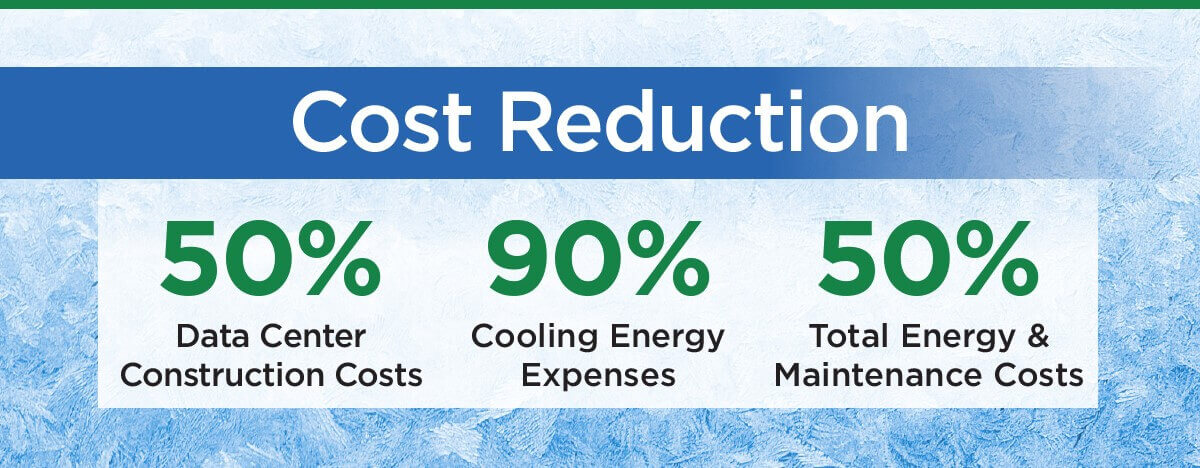
This myth, however, has a grain of truth in it in that data center cooling can be expensive… if you’re toiling with traditional air cooling systems, that is. It’s an electricity guzzler which means bigger bills. Immersion cooling is far more efficient, and because electricity is not a major requirement, it’s far less expensive.
Not only is immersion cooling itself less expensive, it also cuts the total cost of building a data center dramatically. Without the extensive and complex infrastructure necessary for air cooling — raised floors, chillers, air handlers, humidity controls, backup generators, UPSs, batteries, and more — immersion cooling like GRC’s saves you a fortune.
Liquid coolers are also modular, making expansion as well as building and running the data center affordable. And as the technology makes rapid strides, the higher density of computer systems yields even lower CAPEX, OPEX, and total ownership costs.
Myth #2: Air-Cooling Is the Only Way to Go
Far from it, air cooling is no longer the only way to regulate the excessively high temperatures of data centers. Immersion cooling options are far more effective: they use coolants that are safe to immerse electronics in, along with other technologies to maintain racks and racks of servers at a fraction of the cost of deploying air cooling systems.
Immersion cooling systems are easy to use, allowing hot-swapping on the racks and straightforward maintenance. Consequently, servers from many large manufacturers like Dell and IBM work with GRC’s ICEraQ immersion cooling system. GRC’s usefulness does not stop there, and this proven technology has also been deployed by numerous international corporations and US government agencies (military and intelligence) as well as search engine firms and telecom operators.
Immersion cooling offers exceptional functionality for high-density servers running at over 100 kilowatts per rack, applications that have raised the currency of this technology. And because liquid cooling supports any architecture, data centers of all sorts and sizes become simpler to set up and therefore more affordable to manage, from start to finish. While air-conditioning continues to be a great solution for comfort cooling, this 100-year-old technology has outlived its usefulness when it comes to cooling the data center.
Myth #3: Liquid Immersion Cooling Is Unsafe
Immersion cooling is safe, as the immersion technology does NOT use water, but rather a special liquid that does not conduct electricity. GRC, for example, utilizes high-performance, synthetic ElectroSafe® liquid immersion coolants. Multiple manufacturers now make synthetic hydrocarbons that resemble mineral oil. They are non-toxic, non-conductive, biodegradable, and fully recyclable. About as safe as it gets!
Immersion cooling is not only safe, but it also offers additional protection benefits over air cooling. When servers are submerged in the special fluid, there are guards against dust and moisture that would interfere with processing. The liquid also defends against oxygen, vibrations, and hot spots. Together, these threats account for many of the causes of electronics failure.
Immersion cooling technology has been proven to be safe for servers, people, and the environment. The electrically non-conductive liquid does not pose electrocution risks. Also, multiple redundant systems protect against any leaks. If an issue arises in the cooler, negative pressure systems ensure that air rather than liquid coolant fills the volume.
With the unmatched safety profile of immersion cooling, you can install it in any data center, including edge data centers and locations with harsh conditions. For your teams and the environment, immersion cooling offers compelling advantages. Put simply – Immersion cooling makes your data center safer, not less safe.
Myth #4: Liquid AND Air Cooling Systems Are Better Used Together
While it’s technically possible to run a hybrid system that combines liquid and air cooling, generally it makes more sense just to use liquid. With immersion cooling—the most efficient approach to immersion cooling —you eliminate air processing entirely.
Immersion cooling systems do away with the high-RPM fans, filters, and other components of air cooling that need extensive maintenance. As such, the maintenance needs of immersion cooling are much smaller compared to air cooling systems.
Using immersion cooling alone can prevent many issues facing air cooling systems. For instance, you can put an end to bacteria, mold, and other obstructions. No more worries about refrigerant leaking or drains clogging or other electrical components that liquid coolers don’t have. A liquid-only system is simpler to implement than a hybrid system, making it more convenient and reliable.
By switching to liquid-only cooling, you wipe out the need for all that HVAC infrastructure, freeing up data center space that was dedicated to generators, chillers, and other equipment. You can then use the available space to expand compute capacity, or repurpose it for personnel use or any other purpose you want.
Myth #5: Immersion Cooling Causes Corrosion
This myth is false, as immersion cooling protects against corrosion rather than causing it. The liquid, which is not water but rather a synthetic hydrocarbon fluid, keeps out moisture to prevent corrosion.
- A system like GRC’s ICEraQ is engineered to last as long as the data center, which can extend beyond fifteen years. Engineers select materials that complement the liquids involved. System designers factor insulation, coatings, and other protective measures that make immersion cooling unsusceptible to corrosion.
Immersion cooling is designed to function safely and without causing corrosion. Immersion cooling, in fact, mitigates against the corrosion that occurs in air cooling systems!
Get The Latest in Data Center Cooling Technologies With GRC
With increasing amounts of computing power being crammed into servers supporting artificial intelligence and other processing-intensive applications, rack power requirements have exceeded 20 kilowatts (kW) in a large number of facilities.
As high-power racks become more prevalent, air cooling is becoming increasingly unsustainable from an economic and environmental perspective. New technologies have changed, rather, transformed the game and modern applications are pushing the boundaries well beyond the capabilities of air cooling. By leveraging the high thermal transfer properties of fluids, immersion cooling is fast becoming an energy-efficient, energy-saving, cost-effective solution for cooling high-density racks.
Numerous myths have gushed up around immersion cooling for data centers, as is often the case with any revolutionary new technology. If we examine the data, however, we find that immersion cooling offers a safe, non-corrosive method that costs much less, takes less space, produces less noise.
Bringing immersion cooling solutions to the rack can be a complicated process. Finding the right partner is essential to ensuring success. Looking to transition to liquid immersion cooling for data center operation? Look no further than GRC—The Immersion Cooling Authority—that is shattering barriers of heat, space, power, budget, and sustainability.
Get in touch with the GRC team today and find out more about our single-phase liquid immersion cooling technology that offers virtually unlimited capacity that’ll save you money while enhancing your data center’s performance and reliability… And that’s no myth!

As organizations become increasingly reliant on the Internet, data centers are now an integral part of the global economy. And in today’s data-driven, data-dependent world, data center cooling is an area that’s attracting lots of attention. Why? With cooling technology typically accounting for 45% of overall data center operating costs, increasingly powerful processors are generating heat loads that require cooling techniques that are more efficient, more cost-effective, more environmentally friendly.
Deploying traditional cooling methods means huge power consumption rates, and consequently, bigger costs. Factor in spiraling energy costs, green initiatives, and new high-tech coolants, it‘s becoming clear that expensive air cooling techniques are becoming unsustainable with immersion cooling in the data center space enjoying a renaissance.
Companies across the globe are pivoting to liquid-based cooling solutions to keep data center infrastructure temperatures in check. The reasons why operators are transitioning to immersion cooling include:
– the heat absorption rates of liquids are far greater than that of air
– liquids can transport heat more efficiently
– immersion cooling allows for targeted cooling – nearly impossible to achieve with air cooling systems
The savings delivered in reduced operational expenses and increased density lower total ownership costs significantly. Plus, you’ll see a rapid return on investment and you can even save on real estate.
While traditional air cooling systems and newer immersion cooling systems both work to dissipate heat, they employ different mechanisms and yield different results. Air cooling blows the heat away with fans. Immersion cooling shifts heat away with a fluid that has over a thousand times more thermal capacity than air. This means far more effective results.
Given how much more powerful immersion cooling is, we should not find it surprising that it has been used before. In cars, motor oil lubricates also draw heat away from the motor, while electrical transformers and high-voltage capacitors have used oil as an insulator and coolant for decades. The same principle applies in any of these applications: transfer the heat to the small molecules of a liquid, then move the liquid away from the source.
How can immersion systems save your company a fortune? The answer lies in a liquid’s superior cooling ability. This makes your data center run more smoothly, more efficiently, with less waste to slow you down.
#1 immersion Cooling Is More Efficient
The main advantage of immersion cooling is that it does more for less. The greater efficiency of immersion cooling results not only in lower costs but also in less noise and pollution. The other advantages flow from immersion cooling’s efficient operation. Less electricity translates into big savings.
While air cooling requires substantial amounts of power to run the fans, immersion cooling washes away that expense. You can decrease your utility bills dramatically by cooling a data center with liquid immersion. Breaking down multiple cooling technologies to the level of chillers, fans, and other subsystems, the data reveal that server centers use millions fewer kilowatt-hours per year with a immersion cooling solution than a standard air-cooled cabinet. That adds up to savings of hundreds of thousands of dollars per year. Building modeling approaches have found that in any ambient conditions, liquid is more efficient than air.
In data centers, the computer systems are directly dropped in liquid. This differs from “conductive” immersion cooling where the liquid is kept separate from the computer components through heat sinks or heat pipes. GRC liquid immersion cooling is around 95% more efficient than traditional air cooling.
Remarkably, regular rack-mounted computers can run in this bath. Since immersed servers do not have or need fans, total power usage by the server is lowered by as much as 15%. As well as driving down costs and electricity use, this also speeds up the processors. The heat that normally constrains computer performance is promptly and efficiently dumped into the facility’s cooling systems.
#2 Better Performance for Warmer Climates
While immersion cooling works better in any climate, it offers additional savings of electricity and money in warmer regions. There, air cooling is quite inefficient, due to the already warm air into which heat is pumped. Nonetheless, immersion cooling can bring down the temperature just as it can in colder climates.
For data centers in locations with high temperatures, the combination of heated equipment and hot weather is a potentially damaging cocktail if you deploy an air cooling system. Liquid-based systems can handle the heat through their always-on processes, however, so even in naturally warmer spaces you don’t have to compromise on performance.
#3 Faster ROI for Your Equipment Investment
When you spend money on equipment, it has to earn its keep. The faster the return on investment, the more profit. Cooling is expensive. Immersion cooling is far less so, meaning, you recover costs sooner.
A GRC customer in Houston, for instance, uses over twenty-thousand kilowatts per rack. The cost factor alone eliminates an air cooling option but renders immersion cooling a smarter investment. Other data centers use several times as much electricity per rack. Traditional air cooling can chomp off a sizable part of a data center’s power budget.

Immersion cooling contributes to a green, high-tech data center. The equipment is more reliable than air coolers, so your expensive investments are better protected while decreasing maintenance costs and increasing server availability.
Facebook, Google, and other companies running massive data centers are teaming up to develop an open standard for immersion cooling. This represents the future of server management, and the sooner you invest in liquid technology the faster you’ll reap the dividends.
If you want a quick return on investment and lower ownership costs, you want immersion cooling. It does away with the noisy, costly fans that burn through kilowatts and dollars. You’ll also have a quieter and more pleasing workplace. Even for the most demanding data centers using hundreds of kilowatts, liquid is by far the most efficient cooling method.
#4 It Takes Up Less Space Than Fans
A traditional air-cooled system relies on a series of fans to cool various components. The larger the area, the more fans you need. Liquid on the other hand does not take up nearly as much space. Also, you can start small and add modules as necessary.
To make more space-efficient liquid units involves a somewhat different construction process than your basic air-cooled rack, which isn’t much more than a metal box. Liquid instead uses tubs of circulating coolant that makes the entire data center cost far less. Building a data facility with GRC liquid immersion costs 60% less compared to traditional air cooling systems.
Fans not only require their own space, but this also means air conditioners and large generators alongside them. This in turn means more space requirements. With liquid immersion cooling, you kick this overhead out, saving on space and money.
The growing demand for processing power has put pressure on data centers to pack more servers into the same space. Real estate costs money, so space savings translate into financial savings. Having immersion cooling for intensive workloads thus offers data centers a competitive advantage.
Invest in Immersive Immersion Cooling With GRC
Immersion cooling offers you far more efficiency, which repays the initial investment with huge utility savings in the bargain. Moreover, it boosts your processor speeds, reduces noise, takes up less space, and even protects the environment.
For over a decade, the GRC team has been breaking through limitations and setting new standards for data center cooling and efficiency worldwide, providing patented technology that is cost-effective, future-proof, scalable, agile, resilient, and efficient.
Ready to break the heat barrier and shatter limits on data center growth? Get in touch with the GRC team today and learn more about why we are the immersion cooling authority!
Several factors are making immersion cooling an inevitable solution for data centers hoping to thrive amid the new IT realities.
Power density trends are pushing air cooling beyond is thermodynamic limits. The rise of edge computing has I & O professionals scrambling to find cooling solutions that work well in remote, often harsh environments. And sustainability has become a worldwide concern as companies seek to reduce energy usage, energy waste, and limit their impact on the environment.
See What the Future has in Store — Watch Our Video
GRC is proud to partner with Intel® and other trusted industry-leaders to address these challenges. Watch the video below and you’ll hear from Mohan J. Kumar, Intel’s Data Platform Group Fellow, and GRC’s CEO Peter Poulin. They’ll discuss how, working together, the two technology innovators are striving to perfect the entire immersion cooling ecosystem in terms of fluid compatibility, native server design, energy usage, and more.
Organizations across the globe are starting to pay attention to the financial, environmental, and ancillary benefits of immersion cooling technology. Adoption of immersion cooling (IC) is being driven by multiple factors, among these are significant financial benefits and the capability of processing big data at the edge. This has caught the attention of several leading OEMs that are looking to expand upon the utilization capabilities for their respective products within their client’s environment. And they are working feverishly to meet the anticipated market demand for the immersion-ready hardware.
After the adoption of this technology, the next logical step in the lifecycle becomes apparent —which is the maintenance of the technology, from IC infrastructure, to immersed products, to ensuring uptime.
It is highly likely that the first time anyone with even a rudimentary background in IT sees immersed systems there may be an experience of wonderment. I personally had that experience when I attended my first meeting at Green Revolution Cooling in Austin, Texas. Being an IT professional with more than twenty-five years of experience and even with the continual advancement of technology over that time, it is rare that I am stopped in my tracks. This is not as simple as a new software version or faster processing chip. This is on par with seeing an air-breathing organism live in an undersea environment without the need for a breathing apparatus. This is as radically innovative and creative as any blockbuster that Hollywood could possibly fathom. The greatest challenge in that statement is — getting stopped in your tracks and pausing to reflect, does nothing for down time and the need to get a disabled unit back up and running. Truth be told, virtually every technician that is dispatched to fulfill a hardware support ticket who arrives at an immersion rack will be confused about the equipment being contained within a liquid environment and that could exasperate the issue at hand.
Avaso is a unique services company and we have established a long-standing and trusted partnership with GRC as a global services partner. Our technicians are very familiar with the technology we have installed. We actively support preventative maintenance solutions, and are ready to provide emergency dispatch support for every GRC product that is deployed globally. Our team of direct badged technicians and engineers in more that 190 countries support all makes and models of IT infrastructure today, so adoption and familiarity of immersion cooled products is a natural fit. As our team is familiar with the technology, our familiarity as being a third-party services organization translates to the ability of supporting virtually any product that is immersed within the racks, pods, and tanks.
Avaso supports the break/fix requirements for immersed products and does so with a committed response requirement. This may not be the case with most other third-party maintenance providers.
- As GRC’s global partner for installation, maintenance, conversion, and ancillary support solutions, our global team of more than 1,800 technicians spread across 190+ countries are already familiar with immersion cooling technology and applications.
- We work with several OEMs to support expanded warranty and post warranty solutions for clients that are looking to support their immersed infrastructure.
- We are able to meet challenging response requirements to ensure that equipment continues to process data with minimal impact from downtime.
- Avaso’s global field dispatch and global depot network can meet the requirements of hardware maintenance that is deployed within an immersed state.
- Avaso can convert legacy hardware to function in an immersed state, pushing off the need to capitalize a significant hardware investment as part of the shift to adoption.
The potential advantages of leveraging GRC’s suite of products are clear. The financial and environmental impacts of incorporating immersion cooling technology within your infrastructure plan can shorten the timeline to realize your organizational objectives to be Carbon Neutral by a pre-determined date. GRC went so far as to find a partner who could not only support their immersion cooled product suite but enable their clients to leverage a support ecosystem that can convert existing IT servers and switches and support new hardware purchases in the future, as well.
Paul Brundage is an experienced sales executive with more than twenty-five (25) years of experience in building business partnerships on behalf of IT support organizations and considers the GRC/Avaso partnership as one of the most innovative over his career
Experience What Immersion Cooling Can Do for Your Data Center
Send us an email at info@grcmain2025v2.wpenginepowered.com or call us at 1.512.692.8003. A GRC associate will reach out and talk details with you.
sure to read our Guide to Sustainability Metrics with GRC’s ICEraQ® — Going Beyond the Traditional Data Center.
https://www.grcooling.com/learning-center/guide-to-dc-sustainability-metrics/1
Years ago, certain technology services were nothing but a fantasy, except thanks to the continuous technical innovations, it became reality. There is no doubt the non-stop technological evolution has changed our lives to a degree that technology has become indispensable in most if not all areas of life. ICT growth in the Middle East also has its share of the aforementioned leap. We are experiencing a massive pro-technology movement that is being translated to major developments in information technology specially in prominent countries in the region such as Saudi Arabia, Egypt and Turkey.
In recent years, Saudi Arabia has achieved a great success in the information technology sector development and using modern technologies in various fields. It is also working hard and according to deliberate steps to move to digital transformation in order to achieve the goals of the Kingdom’s Vision 2030.
A large number of the MEGA Saudi projects that the Kingdom has recently launched rely on modern technology and information technology in the first place, and it is still working to employ all new technologies and techniques to serve these projects in an optimal way.
The Kingdom seeks to be among the top 100 cities in the world, by upgrading 5 existing cities with smart infrastructure. While as mentioned earlier building mega smart cities where modern technologies play an effective role such as:
It should be noted that Saudi Arabia has a large number of Internet users, as 100% of the population has access to the 2nd and 3rd generation network, while 88% of the population has access to the 4th generation network and Saudi Arabia is ranked 5th in 5G & IOT integration through more than 6,000 cellular towers spread around the kingdom.
Another promising economy in the region is Egypt with its strategic location that helped in making it a significant transit hub for submarine cables and connected to 10 out of 18 cables that pass through its Suez Canal. Albeit the political uncertainty and macro-economic instability wrought by the 2011 revolution the ICT sector has remained remarkably resilient.
The ICT industry is expected to play a central role in driving growth for Egypt’s economy in the coming years. To achieve this, the government has mapped out a plan for development with a number of key aims, which include improving the quality and accessibility of mobile, internet and government services offered to citizens; utilizing ICT infrastructure to improve government efficiency, with a special focus on health, education and tourism; and facilitating the creation of a large and diverse export-focused industry. The government is hoping to capitalize on the country’s competitive advantages and place ICT at the center of its economic development strategy. To this end, the MCIT is working on the ICT 2020 & 2030 Strategies. The framework for the plan focuses on seven main pillars including basic infrastructure, digital content, electronics design and manufacturing, ICT industry programs and initiatives, and legislative and policy frameworks. The government has allocated a budget of $17bn for all these developments. This included $600m for cloud computing, $6.1bn for broadband, and $450m for electronics design and manufacturing. As a consequence of this investments, the government managed to increase ICT GDP by 65%, increasing it to $14.75bn by 2020, up from $8.9bn in 2014-15.
This can be seen in Egypt’s remarkable efforts in fostering the digital innovation by integrating AI to the digital system that helped Egypt move from the 111th to the 56th rank in the government AI readiness index in 2020 and plans for building Mega smart-cities like The New Administrative Capital.
There appears then to be an acceleration in the growth of the ICT sector in Turkey which to be noted is a major Middle Eastern economy with a GDP of more than $720bn in which the ICT sector represents around 3% where it’s valued at $27bn, and a staggering 69 Techno-parks (with an additional 15 underway) and more than 1,100 R&D centers scattered around the country which helps make important contributions to innovation ecosystem and technology development. Also, ICT exports represent an important indicator in the sector in Turkey after the success of almost doubling its exports in a 3 years period (since 2014 to 2017) from $655mm to over $1.1bn while broadening its export markets with the European market considered as the top client getting hold of more than 82% of the Turkish ICT exports.
Also, ICT growth in the Middle East is burgeoning in countries like Qatar and the UAE, which are moving towards knowledge-based economies and making investments in state-of-the-art ICT infrastructure, skills development and e-government. These efforts will enable them to be positioned as one of the leading dynamic and fast-growing economies in the region.
The ICT revolution won’t even be possible without the proper infrastructure both virtual and physical, and the pillar of the physical infrastructure is data centers. A data center is a physical facility where data can be stored and processed and plays a very important role in the future data economy as the world moves increasingly to the web, users and businesses demand quick information. The closer a business is to a data center, the higher the performance of the service. Reliability is the success criteria for data centers, and redundancy assures data center reliability but unfortunately that redundancy comes with a price. Design and cooling have their fair share from the hassle of operating a data center and specially in the Middle East due to the scarcity of white space and hot climate, and different cooling technologies have been tested and used for keeping data centers capable of cooling the hugely increasing demand in computing power but again this comes with colossal costs.
Amongst the emerging technologies that is being used currently in the region is immersion cooling. Advancements of AI/ML, IoT integration has raised demand on high density computing where immersion cooling does the magic, and GRC has been the key player in the immersion cooling market since 2008 with successful deployments worldwide, and with the new series 10 ICEraQ has set new benchmarks for immersion cooling technology. As for the Middle East we are seeing a major Telco operator experimenting with liquid immersion cooling and also an increase in demand of adopting the technology among other verticals of the market (e.g., defense, oil & gas, municipal and others).
In conclusion, the region has been witnessing a paradigm shift in all market verticals and the growth in ICT sector is seeming unstoppable with the blistering lifestyle humans are leading
Experience What Immersion Cooling Can Do for Your Data Center
Send us an email at info@grcmain2025v2.wpenginepowered.com or call us at 1.512.692.8003. A GRC associate will reach out and talk details with you.
sure to read our Guide to Sustainability Metrics with GRC’s ICEraQ® — Going Beyond the Traditional Data Center.
https://www.grcooling.com/learning-center/guide-to-dc-sustainability-metrics/1
Sustainability is the new buzz word in the industry. Corporations and hyper-scalers are demanding sustainable data centers because their customers demand a reduction in the carbon footprint of power-hungry data centers. Consequently, there has been a surge in demand for data centers in the Nordics where power is genuinely ’green’ sourced from hydro and wind turbines, not the renewable energy certificates data centers in other regions rely on.
Having worked in the Nordic region for over 10 years, I have watched this change from indifference for the carbon footprint and its associated power and cooling load to its current place high up the corporate agenda. The reasons in Europe are the fear of legislation from the European Union, the need to report carbon footprint in company accounts, and customer demand. The carbon footprint of data centers was first highlighted for the general public in the excellent Greenpeace report, Click Clean and Dirty Data. This is where we are, so how is it that immersion cooling benefits sustainability?
Put simply, it helps in two ways. By reducing the power demand of the data center and reusing the waste heat from the servers for other applications, immersion cooling has a huge impact.
Let’s begin with the power demand of the data center from the grid and its stand-by generators. This comprises IT load and mechanical load for the cooling/ventilation. Great strides have been made in reducing the cooling/mechanical load in the last few years. In the Nordics, the lower average ambient temperatures help provide ‘free cooling’ for much of the year. Fjords and lakes are sometimes used as a cooling source, but this is not possible in much of Europe and the rest of the world where ambient temperatures are much higher.
So how does immersion cooling help in this regard? The answer is quite simple. The internal fans are removed from the servers since they are not required in an immersion cooling solution. (They would act like little propellors.) Removing the fans reduces the IT energy load by 10-15%, a very significant figure. Essentially, 1000kW of compute can be performed with only 900kW of power — the immersion cooling system would only require a miniscule fraction of this 100kW savings to operate. This has huge implications on every aspect of the data center infrastructure. There is no additional cooling load, which normally ranges from 150kW to 600kW depending on the design and location. The electrical infrastructure is substantially reduced in terms of switchgear and cabling. The stand-by generators are also smaller due to the reduced load, so apart from the reduced power demand to the site there is also a reduced CapEx and OpEx.
The next aspect is the re-use of the server heat. This has become a huge issue in Europe with many cities, including Frankfurt, Amsterdam, and Dublin demanding strategies for server heat re-use as part of the planning/permitting process. So how does immersion differ from air cooling in this regard?
Because it circulates around all of the components, the cooling fluid captures 100% of the server heat, as opposed to 30% in air-cooled solutions. Better still, the temperature of the coolant is around 45C, far more usable than the 20-30C of an air-cooled system. Depending on the site location, the waste server heat can be used in district heating, fish farming, or manufacturing processes like wood pellet manufacture as EcoDataCenter does in Sweden.
There is another aspect which wasn’t considered until recently. The carbon footprint of the construction of the data center itself and its disposal at ‘end of life’. This is now being considered in the calculations of the impact of the data center on the environment. Everything from the building components to the equipment installed, and then the disposal of that equipment at ‘end of life’. This is known as Scope 1, Scope2, and Scope 3. There is a range of equipment that is either not required or is reduced in size using immersion cooling. Consequently, the overall carbon footprint is less. In addition, the building is smaller so it requires fewer construction materials.
In conclusion, it is safe to say the immersion cooling benefits sustainability by significantly reducing the carbon footprint of the data center, probably between 15-30% depending on location and ability to re-use the waste heat. The way forward for a sustainable future then!
Total Data Centre Solutions is a GRC agent in Europe & the Nordics.
Ready to Make Your Data Center More Sustainable?
Send us an email at info@grcmain2025v2.wpenginepowered.com or call us at 1.512.692.8003. A GRC associate will reach out and talk details with you.
sure to read our Guide to Sustainability Metrics with GRC’s ICEraQ® — Going Beyond the Traditional Data Center.
https://www.grcooling.com/learning-center/guide-to-dc-sustainability-metrics/1
The prospect of overhauling any complex IT system is enough to give any I&O leader nightmares. But upgrading air-cooled data centers to immersion cooling solution is a lot simpler—and less stress-inducing—than most people imagine.
Find that hard to believe? Here’s a bit-by-bit breakdown to show you exactly what we mean.
Removing Heat from the Room
The coolant distribution unit (CDU) is the all-important hub of any immersion cooling system. It removes the heat from the coolant exiting the server racks through a coolant-to-water heat exchanger connected to a warm- or chilled-water loop.
In retrofitting your data center with an ICEraQ® immersion cooling system from GRC, you can easily connect the CDU to the air-handlers’ existing water and electrical lines.
Ambient Air Cooling
As advertised, an immersion cooling system will dissipate the vast majority of server heat. Each rack dissipates approximately 500W into the room because the fluid and rack are typically warmer than ambient air.
For this reason, we recommend keeping a room air conditioner around for technician comfort, counteracting heat from transformers, electrical panels, and the like.
Raised Floors
Essential for airflow on legacy cooling systems, raised floors are fast becoming ghosts of data centers past. While not required, you can retain them to keep all wires and piping under the flooring when switching over to a GRC immersion cooling solution. We also offer a below-floor CDU option for use with existing raised floors, allowing for further increased floor density.
Power Planning
Power planning typically constitutes a huge portion of any data center build or redesign. Fortunately, if you’re switching to immersion cooling, you can increase your power budget.
Once you’ve removed all your energy-sapping air-cooled equipment, and we’ve optimized your servers by removing their fans, you’ll be able to fit more servers in the same power envelope—without electrical upgrades.
Fire Suppression
Whether you’re building a new data center from the ground up, or updating the one you have, fire suppression is one of the many items on what can be a very long to-do list.
Remember, simplicity and flexibility are two hallmarks of immersion cooling systems. So, when you migrate to a GRC ICEraQ solution, you can keep the same fire suppression system you have now—and sleep soundly
Water Piping and Infrastructure
CDUs for GRC immersion cooling systems use an automated valve to adjust flow when needed for varying loads. When thinking about water piping and infrastructure, balancing valves may be required depending on what other loads are in your water branch.
You can use the piping from your air handlers for this purpose. Either keep your existing chilled-water system, or reroute to a warm-water loop for the greatest OpEx savings. Water-side free-cooling (without the use of compressors) can reduce operating costs significantly because water temperatures can be increased to 86-95°F (30-35°C).
Data Center Floor Layout
Legacy data center layouts can often be sprawling landscapes dictated by the inefficiencies of air cooling. Since airflow is no longer a factor with immersion cooling, physical access to the racks is the primary consideration when it comes to layout.
GRC ICEraQ systems are arranged end-to-end, making the space-wasting hot/cold aisle schemes of air cooling a thing of the past.
Immersion cooling also greatly simplifies capacity planning. There’s no need to purchase all of the cooling at once. Just plan the room for the future and fill out from one side.
Planning & Financing
Given rapid advancements in and increased reliance on IT, the capacity planning, budgeting, and financing associated with legacy air-cooling are normally fraught with complexities. Because it offers tremendous flexibility and scalability, plus lower CapEx, immersion cooling eases many of these complications.
Another plus: green data center solutions from GRC may also qualify for energy-efficiency government subsidies and tax rebates when upgrading air-cooled data centers. You should also explore taking advantage of hot water reuse revenue streams.
That Was Easy. Ready to Take the Plunge?
Take the first step to leaving legacy air-cooling behind by future-proofing your data center with proven immersion cooling systems from GRC. Contact a data center cooling expert today at ContactUs@grcmain2025v2.wpenginepowered.com or +1.512.692.8003.
When it comes to accurately and reliably undertaking a data center capacity planning initiative, the challenge can be daunting. Do you recall how much planning, effort, and time went into your last attempt? You needed to forecast the necessary compute to meet your mid-term business needs, as well as project your long-term growth requirements, while trying to keep budgets in line. Skillfully and successfully doing all this is no simple task.
The Risk: Capacity Projections
Gone Wrong
Aligning today’s needs with tomorrow’s predicted growth is like hitting a moving target. Traditionally, you had to build with future capacity in mind and hope that your projections were correct. That decision also had a financial impact — forcing you to incur CAPEX today for demand that could be years away. When these five to ten-year projections don’t end up materializing, your data center ends up being either over- or under-provisioned.
The Bottom Line:
Capacity planning is nearly impossible to accurately estimate given increasing demand velocities and the progressively dynamic nature of technology and the applications driving it.
So, Move to the Cloud?
You could just move to the cloud, but in addition to properly migrating data, potential security, and compliance issues, moving to the cloud means you’re losing operational control and might not have desired access for support. Also, depending on terms of use, the cloud can be expensive (up to $500/kWh) and require long lease agreements (up to 15 years)*. This means you’ll be relying on your cloud services’ physical architecture to always remain ahead of latency issues and the tech curve.
Immersion Cooling: All the Rewards, None of the Risks
Instead of precarious data center demand forecasting or moving compute to the cloud, there is another alternative — single-phase liquid immersion cooling. This flexible, cost-effective technology makes planning and provisioning for compute a much simpler process, providing controlled growth, easy management, and proven reliability with less complexity (only 3 moving parts).
Benefits That Go Beyond Capacity Planning
and Hyper-Efficient Cooling
You can’t simply add hundreds of killowatts of IT capacity in a traditional air-based or liquid-augmented solution data center unless you’ve already provisioned, or are ready for a large capital outlay for the additional cooling and power for grey space infrastructure like CRACs, CRAHs, containment structures, or raised floors. With immersion cooling, you have the flexibility to retain control of your operation, revise projections, and adapt to changing business needs on an asneeded basis — quickly.
CAPEX:
There’s no real need for grey space infrastructure at all, only power, water, and Internet. Add compute as you need to grow, not before — no additional racks or cooling support — up to 100 kW/rack at a time or even up to 200 kW/rack if you use chilled water. process.
OPEX:
Since no energy is wasted on legacy DC technology such as air conditioners, handlers, server fans, or extra power supplies, you can reduce power costs by as much as 50%. And, because of immersion cooling’s amazingly small footprint, facility size and the associated expenses are greatly reduced.
Greater Server Reliability:
Immersion cooling also increases the lifespan of your IT equipment due to eliminating server vibration and airborne contaminates. Our ElectroSafe® single phase liquid coolant is compatible with virtually any OEM server that undergoes GRC’s conversion-to-immersion process.
Even More Savings:
Costs can quickly add up if you’re being charged per core software license fees, or by the kWh for cloud services. Because of immersion cooling’s high-density racks with no thermal or power constraints, your data center can run virtual processes faster and use fewer processors, reducing licensing costs.
Quick, Anywhere Placement:
In addition to being easily and rapidly placed into your new or existing data center (raised floor or not), GRC’s immersion cooling systems can be placed practically anywhere — a spare office, dusty arid desert, hot humid outdoor loading docks, parking lots, basements, or on the 100th floor of a downtown high-rise, even in containerized data centers at the edge — wherever close compute is needed most. And, installation takes only days with fewer logistical headaches.
Support Sustainability Initiatives:
Our ICEraQ® and ICEtank® immersion cooling systems allow you to improve your operation’s carbon footprint by reducing energy use 50%, lowering water usage up to 89%, decreasing carbon emissions 21%, and attaining an mPUE of <1.03.
Flexible & Successful Data Center Capacity Planning is Within Your Reach
As you can see, immersion cooling relieves you of all the pain points associated with yesterday’s outmoded capacity planning by providing an alternate approach better suited for today’s world, It allows you to pragmatically expand your data center’s compute on an on-demand basis, alleviate large up-front budget constraints, and increase overall operational efficiency. We think that’s pretty cool.
Ready to Learn More?
Take the first step to simplifying capacity planning — contact a GRC data center expert at info@grcmain2025v2.wpenginepowered.com or +1.512.692.8003. Then, dive
deeper into immersion cooling by watching When “When” Becomes Now: Overcoming Today’s Top Data Center Challenges.